Wednesday, October 31, 2012

October 31, 1945

While going through one of my mother's old jewelry pouches recently, I came across a folded up dollar bill that has been tucked in there since I collected her things after she died some years ago. For whatever reason, I had not looked at it closely until now. This time it caught my eye.

It is a series 1935 A, and clearly printed "IN SILVER PAYABLE TO THE BEARER ON DEMAND" under Mr. Washington's portrait. But more interesting is what was added by hand on the back in what I think was my grandmother's flowery handwriting. Underneath the large centered ONE in black ink, it says: 
 San Juan, Porto Rico
October 31, 1945
Perhaps because that writing is slightly obscured by the crease in the bill, on the right hand border she writes, in blue in, Oct 31, 1945.

Above the ONE, by someone else's hand and pen, is something illegible. On the front, to the left and parallel with Washington's oval portrait, is more unreadable scrawl, in very faded green ink. 
At the very bottom are two centered, tiny, perfectly round holes. 

My grandfather had been a banker in Puerto Rico since 1908, although by wartime he was working as a U.S. postal censor, so I would probably not connect this keepsake with anything having to do with the financial industry in Puerto Rico. I also have not been able to link this particular date with any larger history in Puerto Rico, the U.S., or the rest of the world, that might have affected my family. I imagine my mother knew what it commemorated, and whatever it was, it was important to her too, as she held on to the bill for the rest of her life. I think I'll keep it, too.

And here, for comparison, is a 2009 series (the most recent in my wallet) U.S. one dollar bill. You might also note, it doesn't appear to be backed by silver, gold, or any kind of metal (not sure if that's a good thing):

Saturday, October 27, 2012

What if my early vote is just a little too late?


In The Best Exotic Marigold Hotel, the character Muriel Donnelly (the inimitable Maggie Smith), an elderly woman embittered by a narrow world view and the pain and disability of a rotten hip, is compelled to move to India for her care by the English medical system that would require her to wait half a year for replacement surgery.  We listen in when the English doctor (who himself appears to hail from the South Asian continent) matter-of-factly tells her how long she must wait for relief, her comeback is, “At my age, I can’t plan that far ahead. I don’t even buy green bananas!” This, of course, is among the many lines that made KLK and me snort with laughter.

Today, because we will be away on election day, I tried for the first time ever to participate in early voting, which opened in Illinois on the 22nd.  I thought if I arrived at the nearest early voting location a few minutes after its 9:00 AM opening I wouldn’t have much of a wait. The multi-block search for a parking space near the park recreation building, which is mostly parkland and therefore wouldn’t normally be parked up by residents or errand-runners, should have been an omen. I finally tucked my car into a reasonable spot and headed to the rec center along with at least a dozen other people striding my way. Once inside, I was just as taken aback by the scene as Muriel Donnelly was by the doctor’s bad news (though I had no great comeback at the ready). The line snaked in triple-fashion around the lobby and down the hall leading to the voting booths. My wait would have been at least an hour. While I was more than thrilled to see this wonderful evidence of voter participation, I bailed, because on an errand-ful Saturday an hour is too long.  Fortunately, I will have other opportunities to try before we leave.

At least I think I will. Because Muriel’s curmudgeonly comment inspired a question:  What if I cast my vote and die before the election? If, God forbid, that happens, it turns out that in Illinois, my vote is to be rejected. Never mind the practicalities of the election authority discovering my particular expiration, and the fact that it would be impossible to trace my vote (assuming our votes are indeed anonymous as require by law), isn’t that ridiculous?

But in case you don’t believe me, here’s the 1943 code:
    (10 ILCS 5/19-11) (from Ch. 46, par. 19-11)
    Sec. 19-11. Whenever it shall be made to appear by due proof to the judges of election that any elector who has marked and forwarded his ballot as provided in this article has died prior to the opening of the polls on the date of the election, then the ballot of such deceased voter shall be returned by the judges of election in the same manner as provided for rejected ballots…


If you live in Illinois, best not vote too far ahead of time, just in case your bananas never have a chance to ripen.

Sunday, October 21, 2012

Endorsement: The Best Exotic Marigold Hotel

I'm not up for a full review but before I forget, I want to add my endorsement to that of thousands of others, especially those others who are over, say, about age 60. Last night we watched the most enjoyable human nature flick I've seen in a long time: John Madden's The Best Exotic Marigold Hotel. Reviews on Netflix point out its strengths (which are many, including impeccable acting and delivery of brilliantly written lines, and filming on-site in India - with minimal sound editing to allow an enchanting backdrop of birdsong for instance) and flaws (there are a few, like stereotyping, however successful, of all of the personalities). The essence of the story is that a failing hotel in Jaipur restyles itself as a destination for British retirees, and a motley cast of seniors responds to its overblown, exaggerated, oh-so-appealing advertising only to find a badly-managed, rundown accommodation awaiting them. The hotelier, Sonny Kapoor, (Dev Patel) cheerily assures them, "It will all work out in the end. If it hasn't worked out, it isn't the end." Marigold follows on another of my favorite movies, Outsourced, in its efforts to humanize citizens of India for the West, and to illustrate for the characters, on behalf of the viewers, that our humanity is not so very far apart after all. The movie is truly funny, very colorful, sweet and charming, and (spoiler alert) it has a very happy ending. 

Thursday, October 11, 2012

Blue Cross Blue Shield of Illinois: The Navajo Connection?

I'm not terribly crazy about Blue Cross-Blue Shield of Illinois. For one thing, they apply their own rules inconsistently. For another, their EOBs (explanations of benefits) are mostly incoherent. I do like to know how much of my (outsized) medical bills were covered by them, how much my provider wrote off based on their contractual arrangement with BC-BS, and how, more or less, they arrived at my surprisingly large co-pay amounts (sometimes so mysteriously I am moved to call them up and ask for an explanation). In spite of these regular annoyances (and I've had quite a few this summer with various ailments and mishaps) I've never thought of contesting a decision or asking for review. But tonight I happened to look at the last page of my latest EOB, and saw, to my surprise, that should I decide to appeal their coverage, I might be eligible to receive my determination not in Russian, French, Urdu, or Zulu, but if I'd like it in English, Spanish, Chinese, Tagalog (the language of the Philipines), or Navajo (Dine) [Dineh], I have only to ask. I recommend enlarging the image just to see what written Navajo looks like.
Boy, I'd sure love to know how it is they came up with those particular offerings!

If you'd like to hear spoken Navajo here is a lovely reading of Proverbs 31: The Virtuous Woman. For myself, I'm proud to say there is one (but alas, only one), Navajo word I can pronounce, and it is: To'Hajiilee, the name of a small section of the Navajo Nation along I-40 in New Mexico.


Saturday, October 6, 2012

Division Street Farmers Market

Here are a few visual and aural yummies from a visit to Chicago's Division Street Farmers Market a couple of Saturdays ago:


And of course, no market would be complete without a classy street musician, in this case, Reginald Graig Conyers on the horn (turn on your sound):

Sunday, September 30, 2012

Fermilab, from the inside out


Last weekend, KLK and I enjoyed a most wonderful "backstage tour" on the second bi-annual Photowalk at Fermi National Accelerator Laboratory, or Fermilab. The first fifty photographers to sign up (the tour filled up within a day or two of being announced) were divided into groups of 10, each group bussed in rotation to five different facilities and invited to photograph the equipment and talk with waiting scientists to their heart's content. My previous post on Fermilab focused on the great natural grounds of this international scientific resource in Batavia, Illinois, about 40 minutes west of Chicago. Fermilab is one of about 20 national laboratories and technology centers around the country funded by U.S. Department of Energy contracts as well as the grants from agencies such as the National Science Foundation supporting teams of individual investigators. Fermilab made the news a couple of years ago when the DoE announced it would not renew funding for its largest high-energy particle accelerator, the Tevatron, as its utility has been eclipsed by the opening of the Large Hadron Collider (LHC) near Geneva. However, Fermilab continues to thrive as a center of particle physics experimentation (as of this writing, pending continuation of support in the FY 2013 federal budget, of course) and remains an important locus of international collaboration. For example, researcher groups at the LHC pipe their data to Fermilab's Grid Computing Center to be crunched:
Here's a peep at what goes on at the back of just one of the many large banks of computers within the Grid Computing Center, the combined activity of which is impressively loud and emits sufficient heat that it is not all that comfortable for humans in there:
All of this is connected by miles of spaghetti-like green cable in an open overhead conduit:
One accelerator beneath the Fermilab grounds creates anti-particles by smashing protons together at inconceivable speeds and detecting what new matter bounces out of the subatomic cataclysms:
A truly massive collision detector, where the existence of the target particles is sensed and recorded, is required even for such infinitesimally small subatomic matter:
There is not much at Fermilab that is simple: visible manifestations of the math, physics, programming, and engineering are staggering. I love the big red light at the top of this apparatus in case something goes wrong - like maybe the machines suddenly decide to rise up and stage a revolt?
 
Of course, you can't just go to Wal-Mart to get parts. The fabrication shop is enormous, and provides glimpses into the inner workings of machinery, the purpose of which is well beyond my imagining. It is endlessly sculptural:
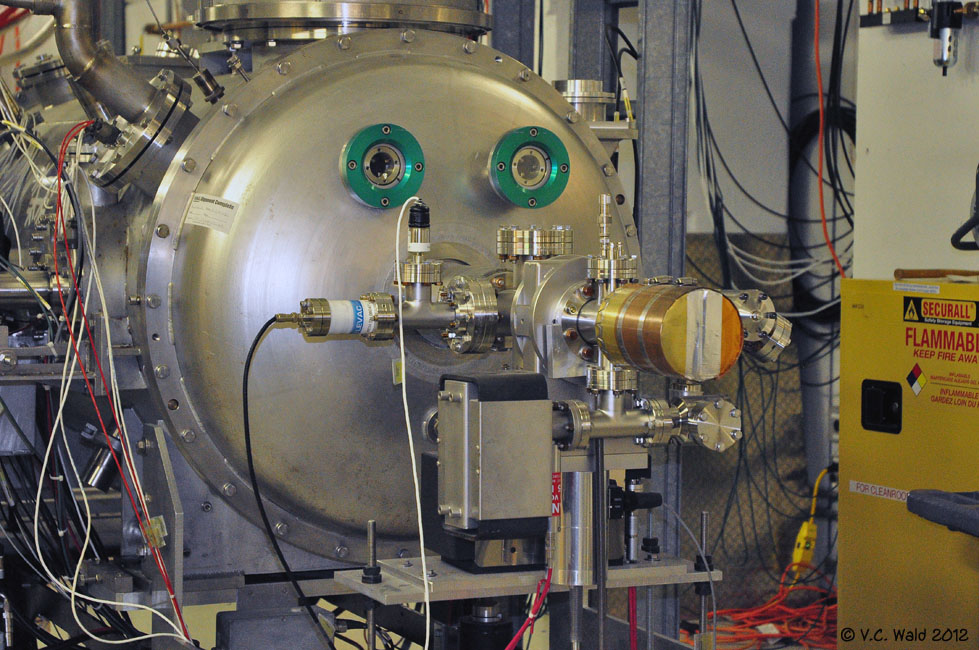
Some elements have personality to spare. This guy, a component in the New Muon Lab (still under development) with his bright green eyes and long brass nose, might be a futuristic relation to Thomas the Tank Engine.
But sometimes, what goes on is laughably simple. Here we see documentation that science is nothing more than duct tape. What it's holding together isn't clear, but together it and its fellow pieces certainly have an arty look:
Or, maybe all it takes to do science is aluminum foil:
Or the ever-useful Saran Wrap, albeit it the biggest piece of plastic wrap you've ever seen:
And, completely familiar and mundane components, which I would bet are nonetheless extremely carefully milled to exacting requirements:
In the absence of an adequate understanding or vocabulary to properly describe all we saw, but in the knowledge that it is important and profound, let me also say that what goes on inside and outside of the halls (and tunnels) of Fermilab is visually delicious and intellectually thrilling. Here are the excited Photowalk participants assembled on the steps of the architecturally-distinguished Wilson Hall,ready to be awed by what was to come (Reidar Hahn photo):

Turn on your sound, watch and hear the grid computers at work and imagine the heat:


Saturday, September 8, 2012

Parkitecture: Mary E.J. Colter and the American Southwest

It's only recently in my many years of visits to America's and Canada's national parks that I've turned my attention from the natural environment to the man-built. My growing interest in these structures - lodging, visitor centers, commemorative markers, and preserved historic, and even prehistoric buildings - became very focused this April on a brief visit to the south rim of the Grand Canyon. Most of the stand-out buildings there were designed and decorated by one extraordinary architect, Mary Elizabeth Jane Colter. She was extraordinary for many reasons, but above all, she was a strikingly talented and inspired woman in a profession and a world overwhelmingly dominated by men. She was tremendously successful in creating structures that not only fit perfectly into their landscapes, but that actually seemed to enhance the them. Born in 1869, trained at the at the California School of Design in San Francisco, and serving as a teacher in the Mechanic Arts High School in St. Paul during era of the Arts and Crafts movement, Colter honed her trade as a designer. Although it's lost to history how it came to be, in 1902, she was hired by the Fred Harvey Company. The Fred Harvey company (which name is still prominent in the American tourism business today) in partnership with the Atchison, Topeka, and Santa Fe Railway, had an incomparable role in developing the tourist trade in New Mexico and Arizona, among other states along therails from Chicago to Los Angeles during the period from 1873 into the 1930s. Fred Harvey ran high quality restaurants first in railroad depots, and then branching out to the lodging business in key destinations. The Harvey Company also notably developed the quality souvenir trade, showcasing the talents of Native American silversmiths, potters, carvers and weavers along the tracks. They provided ground transport as well, guiding tourists to the scenic and cultural sites of the Pueblo, Hopi, and Navajo nations, and the Grand Canyon, Painted Desert, and other natural splendors. 
Colter's work at the Grand Canyon was begun just two years after she joined the Harvey enterprises with the design of a magnificent rim-side building known as Hopi House. In it she revealed her deep understanding of native regional architecture as well as the romance it represented. Here it is today, serving, as it did originally, as a first class gift shop:
Just about 100 miles south, there is a wall at Honanki Ruins, built by ancestral Hopi peoples, that could have been inspiration for the stone work detail with adobe mortar at Hopi House:
Even the inside of Hopi House is still faithful to the architecture that inspired it, and it still serves as a purveyor of high quality Indian arts.
Colter's next Grand Canyon project was another gift shop, Hermit's Rest (1914), at the far west limit of the developed area of the national park. Although Hermit's Rest is not as substantial as the multistory, large-footprint Hopi House, it also reflects terrific creativity and imagination. Hermit's Rest is not based on Native American design, but rather suggests the spontaneous ingenuity of a free-spirited mountain man in its use of stone found in situ. Here is a view of the Seussian chimney, with a hint at the grand sights beyond:
So why does a gift shop need a chimney? Because the most prominent feature of the interior is a massively outsized fireplace niche:
Note the proportionately large and stylish lantern centered above. Colter not only designed exteriors, but she was meticulous in the choice and placement of interior features as well. Like Hopi House, Hermit's Rest is still used as a gift shop today.
Also in 1914, the Lookout Studio was erected on the very verge of the Grand Canyon:
The Lookout Studio reveals her fine Arts and Crafts sensibility blended with references to regional native stone-masonry.
Every rock was chosen and placed at her direction, every window was detailed according to her design. Originally a photography studio selling images of the Grand Canyon, Lookout Studio is today yet another gift concession.
In 1932, the Watchtower at Desert View, at the far eastern extent of the developed south rim, was opened. The Watchtower serves the primary purpose of affording magnificent views up and down the Canyon while itself resonating both with the color and character of the stone strata on which it perches, and the work of Native builders in the distant surrounds. I consider the Watchtower to the pinnacle of Colter's productivity at the Grand Canyon. 
In its circular shape, the tower re-imagined rare archaeological gems such as the Round Tower at Mesa Verde National Park, but multi-story structures were not uncommon among the dwellings of the pre-Columbian peoples of the southwest. This is the Wukoki Pueblo archaeological site, roughly 65 miles east of Colter's Desert View Watchtower.

Colter collaborated with Hopi painter Fred Kabootie to realize her interior designs, references to graphic arts of several southwestern cultures, including the Hopi, the Navajo, and the people who came before them.
Painted petroglyphs on the mezzanine of the Watchtower echo those to be seen at Petroglyph National Monument some 400 miles to the east:
No detail was left unexploited; when not apt to recall Native American style, Colter turned to Arts and Crafts, which in turn was suggestive the ironwork of the Spanish explorers, as here in the door at the base of the tower:

The Watchtower at Desert View, the Grand Canyon below and Navajoland beyond.

Colter designed and decorated other structures at the Grand Canyon, including Bright Angel Lodge and Cabins at the rim, and Phantom Ranch,lodging for intrepid travelers to the bottom of the Canyon. She also designed and decorated numerous other distinguished buildings, including the renowned La Posada Hotel in Winslow, Arizona (1930).La Posada was ideally sandwiched between Route 66 in the front, and the Santa Fe Railroad, which still runs immediately behind the hotel, positioned to serve both the growing automobile trade as well as passengers arriving by rail. A romantic stay at La Posada included hospitality, fine meals, and tours into Indian country, the Painted Desert and Petrified Forest and beyond, all provided by the Fred Harvey Company. In spite of the pall the failing economy put on tourism, the hotel survived until 1957. The Santa Fe Railroad converted the hotel into offices, eventually essentially abandoning it as it fell into disrepair. In the mid-1990's, developer Allan Affeldt and partners invested millions into restoring Mary Colter's magnum opus to its former purpose and glory.
I visited in 2011 and again in 2012. The results of their work and dedication is nothing short of magical. Although the Indian, Mexican, and Spanish treasures amassed by Mary Colter were auctioned off when the hotel closed in the 1950s, Affeldt's group has respected her sensibility in its highly successful restoration efforts. Today the hotel is full of new life, with commodious, charming, and utterly memorable private and public spaces without and within:
Colter's hand touched many other still-extant structures in the region, including the interior of the Painted Desert Inn of Painted Desert National Park near the Arizona-New Mexico border:
 
 And that of the famous La Fonda hotel in Santa Fe, also on old Route 66:
Hard though it is to believe, given her extraordinarily productive originality and creativity, in her lifetime, Colter was virtually unrecognized outside the confines of the Santa Fe Railroad-Fred Harvey Company collaboration and the praise of a few industry critics. Today, Mary E.J. Colter is an icon of her era. 
 Mary Colter, 1890
For further reading, I recommend the beautifully written and produced Mary Colter: Architect of the Southwest, by Arnold Berke, Princeton Architectural Press, 2000. Although Berke's treatment is nearly comprehensive, one subject never broached is that of cost. If anything is clear from the Mary Colter story, it is that execution of her work had to require exceptional investment, and it appears no budgetary restrictions were imposed on her creativity. This is a historically relevant facet that I wish Berke had documented.