Sunday, September 8, 2013

The Built Environment: Parkitecture Grand Teton National Park

I've blogged on the subject of "parkitecture" both in the context of founding mother "parkitect" Mary Colter, and the wonderful Parkitecture Flickr group (now up to 192 members and 1,982 exemplary photos I might add) to which people post their images of  endearing man-made structures -- historic, pre-historic, and contemporary -- that add to the aesthetics, function,  and appeal of our national (and other) parks and public spaces.

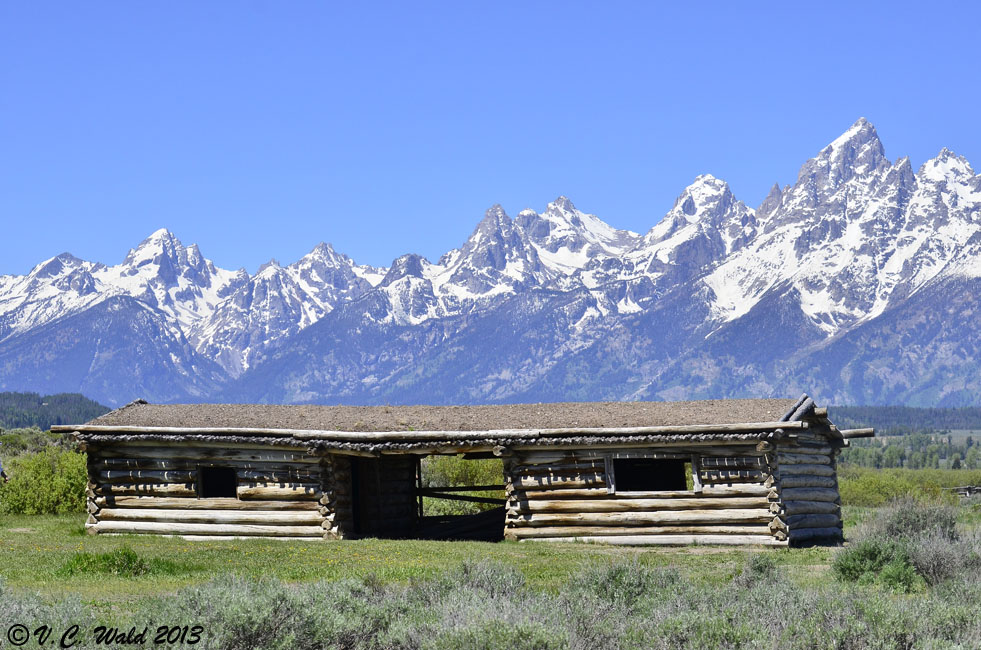
Yellowstone and Grand Teton National Parks are both especially replete with such buildings and structures. This year, for example, we stopped by the historic Cunningham Cabin in GTNP: 
The Cunninghams settled in the area in the 1880s, toughing out baking summers and long, cold and snowy winters on the sage flats of Jackson Hole; the soil is poor, and water unreliable. Indeed it was drought that finally did in their enterprise.  Now all that remains of the homestead ranch is this "double pen" style cabin, but oh my, without question, the view is still beyond compare.

Among GTNP's many other very old structures is the White Grass Dude Ranch, a mile or two up the stony, rutted, alternately dusty and gummy-mud road to Death Canyon trailhead. I first came upon White Grass in 2006, when the buildings were barely still upright and the marmots made homes in the cabins, emerging through holes in the roofs to safely check on interlopers (me).
That day I was the only person wandering around the stunningly beautiful "park" (wide open flat area), and there was no information, either on site or on the internet, to clue me in as to what I'd stumbled upon. Flash forward to 2013, now with an informative sign near the side of the road and heartening progress towards preservation:
A homestead of about the same era as Cunningham's, White Grass Ranch first accommodated paying guests -- tourists to be sure -- in 1919. Though sold to the National Park Service in 1956, its owner at the time continued to operate it for dudes until 1985. Mouldering and neglected for the next 20 years, finally now, as noted on the National Park Service's Grand Teton National Park website, "...the National Park Service, National Trust [for Historic Preservation], and the Western Center for Historic Preservation seek to rehabilitate not only the thirteen remaining cabins, but the cultural landscape as well." But it's even better than that: the prime mover in the project, the Western Center for Historic Preservation, is "...an education and resource center dedicated to the preservation and maintenance of cultural resources in our Western national parks. The center promotes leadership in preservation education and skills development with government partners, non-profits and educational institutions committed to the same goals." The project at White Grass is a working laboratory that trains volunteers and National Park Service personnel in the conservation and restoration of historic structures. Once completed (2016, if all goes well) it will continue to be used as a training facility for what I consider to be one of the most worthy of possible goals of the National Park Service, the preservation and rehabilitation of historic and rustic buildings. Next year when we go back I'll have updates.

Grand Teton Park also has several contemporary, and equally significant structures; I've previously blogged about the newest, the Laurance S. Rockefeller Preserve Center.  Notable among other very recent GTNP builds is the Craig Thomas Discovery and Visitor Center at Moose, Wyoming,  which opened just inside the main entrance to the park in 2007.  Designed by architectural firm of Bohlin, Cywinski Jackson, it represents quintessential 21st century parkitecture in its visually successful resonance with its natural the environment, the backdrop of the Grand Teton range. This is the inspiration the designers had to work with, as viewed from the visitor center parking lot:
And how they echoed it in the roof-line from the Japanese-style-like front entrance:
 And how it looks from the opposite site (mountains to my back):
And what visitors see from the inside as they stroll through the educational exhibits on the geology, wildlife, and cultural history of Grand Teton National Park:

Sunday, September 1, 2013

Man-made wonders: Jackson Hole Aerial Tram

Not only are the natural wonders of the greater Yellowstone area feasts for the heart and soul, but so   are a remarkable number of the man-made objects and structures. For the first time in many years, this June KLK and I picked an opportune day to ride the Jackson Hole Aerial Tram from Teton Village (a metastatic ski resort of expensive condos, romantic luxury homes, good and not-so-good restaurants, spas, outdoor sports vendors of all kinds, and an ever-enlarging cement parking lot blotting that little spot in Bridger-Teton National Forest immediately south of Grand Teton National Park) to the top of North Peak of Rendezvous Mountain. It had been 7 or 8 years since we last rode the original tram, which opened in 1965 to serve skiers and snow boarders in the winter and hikers and sightseers in the summer, but we remembered the experience of being gently lifted 4,139 vertical feet above Jackson Hole as thrilling.
Original Jackson Hole Aerial tram, 2005
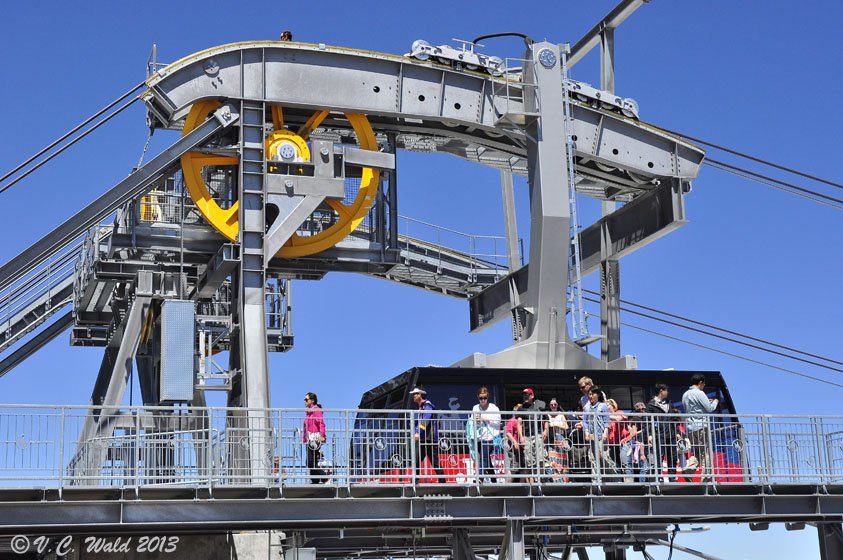
The old tram, with its small capacity and ever-increasing maintenance needs, was replaced in 2008 by a beautiful 100-person cabin and new supporting infrastructure, bottom-to-top (here's a fascinating blog about the process). This was our first ride on the new tram, the mechanics of which were built by the Swiss (who else?) company,Doppelmayr CTEC.  This is what the new workings look like at the base:
Now I know how it feels to be inside a somewhat oversized Swiss watch.
Waiting our turn.
Leaving the resort below...a corner of Teton Village in the foreground, a bit of the flats of Jackson Hole in the middle, and the Gros Ventre Range in the distance. 
It's a long way up to 10,450 feet. Because there are year-round services at the top, there is road (not open to public vehicles) that makes a great 7-mile hiking trail. There are foot races up, but we, being normal, have ridden the tram up and walked down.
Picture 100 happy sardines -- I mean happy skiers and their skis and poles and snow boards and bulky ski suits -- crammed in there. Better than the old 50-person tram, to be sure. We're above the treeline, ascending more vertically along the last stretch and up close and personal with Corbet's Couloir, a sheer rock face that in winter becomes a suicide drop on every hot-dog skier's do-or-die list.
Corbet's Couloir. Aren't you inspired to ski right off that cliff?
There's another Swiss watch at the top.
And a fancy communications get-up on the roof of Corbet's Cabin. 
The angle of view is so wide it's a little hard to pick out from the ledger which peak is which, but to be sure, the pointy one touching the sky is Grand Teton.

Some serious geologic uplift, subsidence, and at one time, glaciation going on, too. Click on the photo to enlarge for detail.
Here's KLK at Corbet's Cabin (the building with the prickly communications gear on top), best place on earth to score a hot cocoa with a view. Also not a bad place to have a hot dog and chips, use the restroom, get warm on a cold day (which this was not; on a windless, sunny summer day it's nearly shirtsleeves -- with sunscreen -- up there). 
That flat-topped peak is the rim of Cody Bowl, where you can hike or ski. When the wind suddenly started to gust aloft, we reluctantly rode back down, below treeline here now. People often report seeing wildlife -- moose, bears, marmots, soaring raptors, apparently unperturbed by the big red box sliding up and down overhead -- in this area. This trip we zoomed past a mule deer doe, alas, too quickly to get a photo.

I am not a religious person, but there is something about being at the top of a tall mountain that makes me feel close to The Divine.
 
 Grand Teton peak viewed from Rendezvous.


Sunday, August 25, 2013

Just Life, and a Good One at That: Photo Essay

From my last couple of posts a reader might be inclined to avoid Yellowstone and Grand Teton National Parks as depressing places good only for witnessing that Great Bitch Mother Nature wreak her havoc. Not so, let me assure you! They are in fact supreme places for lifting the spirits, making the heart sing, and, mostly, for being constantly awed by Nature at her best. Here are some examples, in no particular order. I'll keep commentary to a minimum so you can judge for yourself.
Early morning view, Grand Teton range
Newborn elk calf, Mammoth Hot springs, just learning to stand and nurse. The elk find safety from predators to be a fair exchange for the presence of humans, and their vehicles, and their buildings.
 The hike to Hidden Falls, Grand Teton National Park.
Lone Star geyser is an easily accessible back-country geyser in Yellowstone. The cone itself is about 12 feet high, and in full eruption reaches 30 to 40 feet and lasts half an hour. It's one of very few geysers that can be safely approached closely enough to fully sense the power of the eruption.
The trail to Lone Star geyser follows the Firehole River for a couple of miles.The Firehole is a great trout stream.
Bacteria and algae capable of thriving in extremely hot, very acidic or very basic, highly mineralized conditions in Yellowstone's thermal features - this one is the edge of Black Pool in West Thumb Geyser Basin - are responsible for the glorious colors.
Speaking of glorious color, these are the Red Hills, a little east of Grand Teton National Park in the Gros Ventre Wilderness; the red color comes from iron. The lake is Lower Slide Lake, formed by a sudden massive landslide that dammed the Gros Ventre River in 1925.
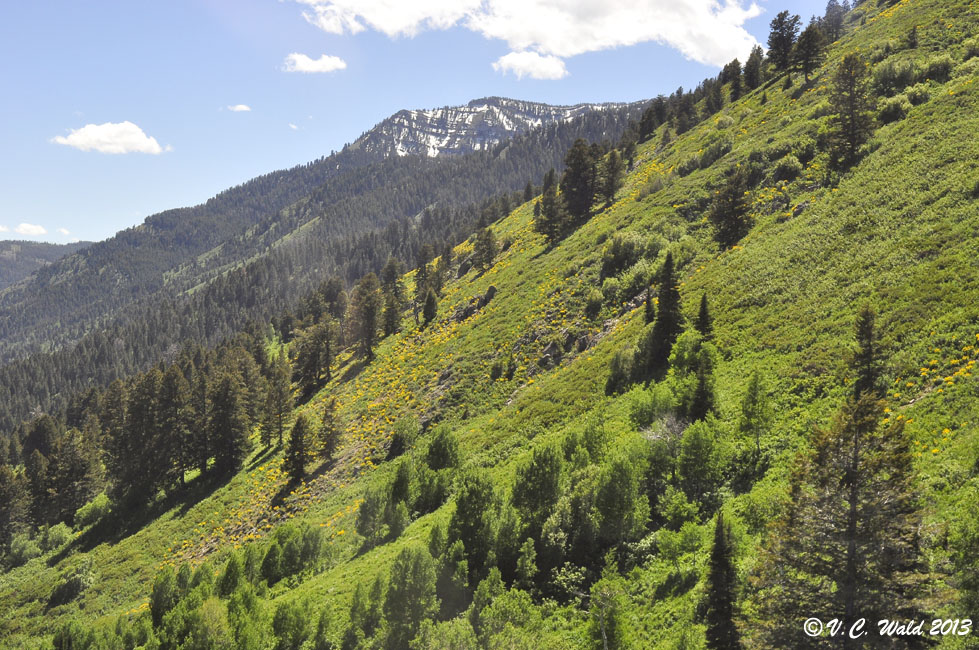
 Arrowleaf balsamroot all abloom in June, Grand Teton National Park.
Trout Lake, Yellowstone National Park. We looked for otters but saw only the fish they feed on, the Yellowstone Cutthroat Trout (classified as a threatened species), gathering near the inlet in preparation for spawning.
The female alpha wolf of Yellowstone's Lamar Canyon pack, known as "Middle Gray" hauling brisket of elk back to her pups.
Bison calves practicing being bison.
 
The Grand Teton Range, beauty beyond compare.

All photos from June 2013.

Tuesday, August 6, 2013

Life, and Death, and Life in Yellowstone

The miracle (or I should say, one of the miracles) of the greater Yellowstone and and Grand Teton world is that it can be so utterly refreshing and restorative, removed and separate from one's daily life elsewhere on the planet, and within an instant dramatically compel re-examination of one's emotional equilibrium and moral assumptions. This June we were fortunate (yes, that is the word I want) to twice witness the enactment of one of the Circle of Life's most enduring events: the interaction of predator and prey. Such scenarios are always a reminder that while it's one thing to sit in front of a TV watching a nature show depicting African lions taking down an impala, far away in time, space, and psychological impact, it's quite another to be standing "real time" in Yellowstone watching a black bear zigzag determinedly through sage brush searching out the mule deer fawn its nose tells it is hidden there, flat to the ground and motionless, as the fawn's mother panics, attempting everything she knows to derail the determined predator's mission.
We came upon this scene at the turnoff from the main road to Roosevelt Lodge, where we were staying. Arrayed in the large parking lot at the intersection, itself an unpretty but necessary destination with its vault toilets, an enormous bank of recycling bins, gas station, and rangers office, were a hundred onlookers, cameras and binoculars aimed at the sage where a black bear's nose would pop up to gather molecules of scent, trying to hone in on the location of their origin,only to disappear in the brush and rise again seconds later, yards away...
 
 
...while a mule deer doe, acutely aware of how the situation was unfolding, charged the bear, ran between it and her child, paced frantically, running toward and from the bear in the hope it would follow her, then repeated her efforts, at a loss for what else to do.
Not initially succeeding in its olfactory efforts, the bear rose on its hind legs in an effort to locate the fawn visually:
Finally, after more than twenty minutes of this tense drama, the bear plunged into the tall sage where we could not see it from our stance, and then we heard the tiny scream. The assembled audience gasped and went quiet, only to clearly hear the second, and final scream. It was over, and the doe knew it.
We did not see the denouement itself, as the bear hunkered down on its prize out of sight. The mother cried in the way wild animals do, silent and still. Someone later saw the bear drag the remains of the little carcass away; the doe was still in the area when we departed the park a few days later.

What we had witnessed is a daily occurrence in the wild: an animal, a deer, invests enormous amounts of biological energy in producing and then nurturing offspring; then suddenly, within a few minutes, another animal has purloined all of that energy for its own welfare and that of its offspring.

Then one evening we were meandering up a mile or two of gravel road in an area that happens to be among the most beautiful in the park. The ridges and valleys and narrow canyons also form a bottle neck between two vast open spaces, and thus offer the chance to see concentrations of wildlife, including, often, wolves. That was not to be our fate this evening though. As we turned around and headed back, we saw a car facing in the opposite direction pulled up close to the edge of the road; the front door was open so all we could see there in the grassy sagebrush was the busy movement of something furry, so we too stopped to look. What we saw was this creature, an American badger. Badgers are very close to the ground, with beautiful striped facial markings, and a snout (usually with dirt on it, as in this case) and powerful forepaws designed for digging.
Badgers are underground burrowers, and this one had an agenda:
It was obviously committed to its task, as it was within only a couple of feet of the edge of the road, where by now about 15 watchers had assembled. In spite of the albeit respectful human presence, it continued excavating furiously.

Someone happened to look away from the badger's work (one should always pause to look around when so focused on wildlife activity, it pays off in all kinds of ways) and pointed to an all but unnoticeable hole in the gravel road. What we saw was remarkable: one after the other, four mouse-sized animals, almost the same color as the gravel, literally popped out from the hole, landing nearby on the gravel. I thought they were mice, but on close inspection, they proved to be infant ground squirrels.

They were so young their eyes were still sealed shut, and they could barely walk.
This one made it to the side of the road, but there hit the limit of its capacity to ambulate.
The mother was not to be seen, but we presumed she had ejected her pups from their burrow in reaction to the badger's vigorous adjacent efforts to reach the tunnel where the babies were nesting. At this point the badger had quietly disappeared into its hole, so all eyes were on the ground squirrels. Lots of us took photos; even Bob Landis, the renowned cinematographer, happened to be there (he's almost always in the park, which is how he captures some of the phenomenal action that he does), so I know some truly first rate footage exits of the little creatures.  But since we were all experienced wildlife-watchers, and have it deeply engrained in us that one does not interfere with Mother Nature, we all stood around marveling. Nobody took any action, even in the full knowledge that once we all dispersed, the next car to come down the road would have no chance of spotting the pebble-sized pups before squashing them. Then finally, a man leaned over and one-by-one picked them up in a paper towel, setting them down in the grassy sage at the side of the road.  Not 5 feet from the badger's hole. Still, no one said anything -- certainly no one criticized him for what he did, and in fact probably many were relieved he had done it. Not knowing what else to do in the fast-fading evening light we finally all did disperse back to our cabins and tents and campers, all with the unexpressed knowledge that we had just made it easy for the badger to get its tender ground squirrel meal, and perhaps to provide a nutritious meal to its own offspring.

The so cycle of life, and death to enhance the chances of other life, goes on.

Tuesday, July 30, 2013

That's a Good Question!

Regarding the post below about Celebrity Grizzly 399 and her family, reader merinz posted the following questions:  Does the mother have identifying marks? How can you be sure it is her? Well, personally, I usually have to rely on the park rangers, who always show up seemingly immediately when a bear appears near people (which brings up another question, for another blog -- once I figure out the answer: how do they get there so fast?). But of course, there are park wildlife managers in charge of identifying and tracking specific animals, particularly those like bears and wolves that are most likely to attract the attention of people. The parks are also hosts to researchers who collaborate with park staff and whose resources (grants) help offset the costs of  the technology and labor to do so.

The first year I saw her, 399 was sporting a big heavy tracking collar, and in some photos taken at this same sighting, it is apparent that her right front leg had been shaved, most likely to enable blood to be drawn. I would guess that the blood was analyzed for DNA, among other things such as indicators of health. To accomplish collaring and blood sampling (as well as physical measurements including weight, examination of teeth to estimate age, sex determination, and so on) the animal has to be darted and sedated, a dangerous proposition for animal and researchers alike. However, once a particular animal's DNA is on record, subsequently hair rubbed off on the side of a tree (or telephone pole, see Discouraged, But Not Hopeless) or scat can be used to verify whether it is the same individual or another animal.
Behavior is another, less invasive clue; bears are strongly territorial and a sow like 399 is highly likely to return to an area in which she has felt secure raising her young and can find plenty of food and shelter. Probably the only happenstance in which a new sow with cubs would show up in the same vicinity is if 399 were to die and one of her daughters were to take up housekeeping in the area in which she had been raised.

I don't know if 399's collar eventually fell off of its own accord (some are designed to deteriorate), or was intentionally removed, but she definitely didn't have it when I again saw her in 2011. It is possible that by then she had an ear-tag, which, if subtly colored in low light would have been difficult to see. Although as far as I know the tags do not contain a chip that can be read remotely, I wouldn't be surprised if the color were coded for the bear's identity, and the tag itself imprinted with identifying information that could be read close-up should the bear be captured, sedated, or, found deceased.
Tags are common everywhere people and animals interact, such as on this Churchill, Manitoba polar bear, with one in each ear matched to its fur color. 
This black bear in Yellowstone National Park is sporting one big red earring. While by no means every Yellowstone bear is tagged, it's not a rare sight. Drives photographers nuts!
 Tagged and collared Yellowstone coyote.
Bull moose with radio collar, Grand Tetons.
The elk cow in the right rear has a big collar, Grand Tetons.
Bighorn ewe with extremely large numbered collar, Whiskey Mountain above Dubois, Wyoming.

As is evident in the photos, especially the older tracking collars have big battery-electronics packs. Most are tracked from the ground by graduate students with a device on a belt pack wired to an antenna at the end of an arm slowly turning in the air to pick up the telemetry signals unique to each tracked animal.

Wildlife -- usually in groups like bison herds -- is also visually tracked from the air. If the individuals within the group are known, as wolves are to researchers and other observers, aerial tracking is an effective way of following the movements of individuals of interest.
Tracking plane, Grand Teton National Park. No, it didn't crash into the mountain side,  but the view must have been thrilling.

Other methods of tracking wildlife (in addition to a student slowly twirling an antenna overhead) include satellite and GPS tracking, and individual markers like bird bands that require visual contact and a good spotting scope to be read. The Migratory Connectivity Project has good, succinct descriptions of these and other methodologies for tracking mammals, birds, and fish as they cover great distances across the globe. The US Geological Survey (USGS) has a page listing the projects of the Interagency Grizzly Bear Study that gives examples of the various aims of tracking bears. Here's an outline of the Greater Glacier (National Park, north of Yellowstone) Bear DNA Project, in which  methods of identifying individual grizzly bears and black bears is described.  And for a more comprehensive discussion of radio-tagging (mammals, birds, fish) see the excellent and thoughtful Mech, David L. and Shannon M. Barber, A Critique of Wildlife Radio-Tracking and its Use inNational Parks: A Report to the U.S. National Park Service. February 6, 2002.