Sunday, June 26, 2011

I'm so glad you didn't knock! Part V

 Lucinda, "Grandma" Betts (a friend and relation) and my friend LCB at THE kitchen table, July 2008
In late April-early May this year, I had a rare opportunity (thanks to a conference in Scottsdale, Arizona) to get myself back to the Southwest after a hiatus of nearly three years, and took advantage of the opportunity to bring KLK along to see a magical region he's had no previous chance to get to know. After the conference we journeyed north from the Phoenix area, making many stops at special places through the middle of Arizona and eastward across Interstate 40 - the progeny of historic US Route 66 - to Albuquerque, New Mexico. Albuquerque is just 45 miles east of Laguna. In spite of our myriad lovely experiences to that point, what I looked forward to most was seeing my friends on the pueblo. KLK had never met them, but heard about them often over our years together. After a refreshing sleep at my favorite B&B in Albuquerque, we jumped in the rental car and backtracked to Laguna, specifically, to the little town of Paguate, my friends' heritage home. We pulled into the yard, automatically locked the car as we urban-dwellers are compelled to do (ridiculous behavior in Paguate, to be sure) and walked through the front door, which leads to the biggest room and my beloved favorite heart of the home, The Kitchen. Lucinda popped right up for a big embrace. Her quick, quiet personal aside to me was, "Oh! I'm so glad you didn't knock!" Of course, family, after all,wouldn't knock.
The "black thumb"natural landmark, Pueblo of Laguna

Thursday, May 26, 2011

I'm so glad you didn't knock! Part IV

There are lots of ways to honor the life of of a lost loved one, and one of the best is to have a really good party. A Laguna tradition, somewhat in the vein of a potlatch, is to hold a "Grab Day" or a "Throw" - which it is depends on where you stand, literally. Just about a year after Liz's death, when daughter Lucinda, who also raised her family in the old adobe house, found out I would be visiting (with my dear old friend, Liza B.) she said, "We'll have a Throw in memory of Mom when you come!" as if I really understood what that meant.The date also nearly coincided with Liz's patron saint's feast day, a happy convergence all around. 
So as I now know, the idea is that with family, friends and neighbors from far and wide gathered on the street below, from the roof the hosts toss (or, really throw) down to them blessings and gifts like canned and packaged foods, kitchen towels and gadgets, school  supplies, and the like. Of course I asked if we could bring something, and of course, the answer was, "Oh no, please just bring yourselves!" and of course, we brought a case of little bags of chips. Everybody else contributed as well, bringing the goodies in laundry baskets or dish tubs. When it came time for the big event, a neighbor across the way offered her nice flat-roofed house, since the old adobe has a steep roof on it. There was so much stuff it more than filled the bed of a pick-up and the entire back section of our rented SUV just to be moved across the street to the neighbor's, then handed, bucket brigade-style, up a ladder and onto the roof.
By this time quite a crowd had gathered. Liza and I were invited to the roof, deeply honored to be among those sharing the goods and good wishes. The festivities began first with the thanksgiving and blessing, ladles of water from a beautiful traditional olla (pot) gently sprinkled on the people below, followed by more colorful and boisterous anointments!
Then the fun and hilarity began - we threw and threw and threw - Liz was well-loved and her descendents very much respected, so there were lots of participants, family and friends on the roof, and ten times more people down below; I think it literally took an hour for the seven or eight of us on the roof to share the wealth. As a grand finale, all the baskets went flying. So you might have come with a basketful of goodies and left with a handful, or come with nothing and filled a basket with soup cans and sodas and chips and cereal and paper towels and shampoo and pens and socks and...yep, I know what you're thinking: there is always the potential for a grabber to get clocked on the head, but everybody's willing to risk it, and of course, Liz's Throw went off without a mishap, and with abundant joy and happy memories for everyone. 

Sunday, May 22, 2011

I'm so glad you didn't knock! Part III

The early 1970s were not done with this family yet.  Elizabeth's husband, the childrens' dad Ray, whom I think I never met, died from ill health. I don't know how old she was, but beloved Grandma Paisano also passed away during this time, leaving a hole in everyone's heart.
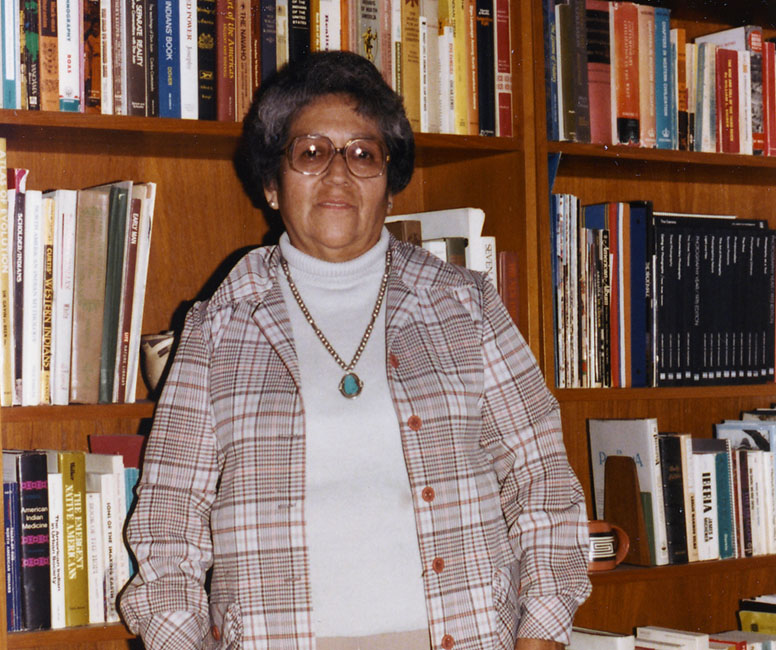
In spite of these terrible soul-smashing blows Elizabeth really came into her own in both family leadership and community service following these years, when, without any particular background or training, she was appointed director of the Laguna Library. By the later 1970's she became increasingly renowned in the world of indigenous librarians; she visited us when business brought her to Chicago in 1979 for a meeting at the Newberry Library. Through recent Google searches, I have come to learn that she also attended conferences in such places as Auckland New Zealand, and Regina Saskatchewan, and testified before the Gates Foundation and Congress. I stood in front of the library with her in 1977 when was still in a little adobe "box" (above) but before she was done, she had shepherded the library into a beautiful new structure to house its books, digital resources, and archives, and from which to offer services to the 7,000-some enrolled members of the tribe.
Elizabeth at my home in Chicago, 1977

Liz's spirit lives on at the Library, for which she worked tirelessly until just a few months before her death in 2007, at the age of 82.
Elizabeth in front of the new library sign, photographer and date unknown.

I'm so glad you didn't knock! Part II

In 1972, I entered the graduate program in cultural anthropology at Arizona State University in Tempe, Arizona. By this time my parents had divorced, my mother was living in Spain, and my relationship with my father, who was still in Indiana, was beginning to wear thin. But my friends in Laguna opened their door to me, so that's where I went for any long weekend away from school. The drive was "only" 450 miles, but in those days the speed limit was 75, and I had all the wakefulness and stamina needed to do it within eight hours or less and to turn around to do it again back to Tempe a few days later.
All the kids were growing up. Mike was almost a man; his younger brother Wally was doing well in high school, and the four girls were blooming. 
I was fortunate to be able to spend lots of time with them, their wonderful mother, who by this time was the energetically devoted director of the Laguna library, and Grandma. I got to know the area well, and had many opportunities, for example, to take Grandma and one of the girls to see Grandma's friend, another grandma, in Hopi. While in Hopi we were blessed to witness the famous sacred Snake Dance, something most outsiders never have the good luck to observe.
Then one day I got the call from Elizabeth. Wally, distraught by a love interest's rejection, tried to take his own life. He managed to shoot out the roof of his mouth and one eye, but survived. Good surgeons restored his face, his speech, and, with an artificial eye and lots of good therapy, his mental and physical health. Soon, the affectionate and playful young Wally happily went off to attend college at New Mexico State, but in 1973, in a snowstorm, his car was struck by a jack-knifed semi-truck, and Wally was killed.

Saturday, May 21, 2011

I'm so glad you didn't knock! (A Love Story) Part I

The year I was 3, my father, a professor, spent the fall semester visiting the University of New Mexico in Albuquerque. Those were the days when long drives in the country just to take in scenery was commonplace family entertainment. My parents, who were lovers of dramatic land and who had great appreciation for Native American cultures, especially enjoyed the southwest. One day the three of us, my mother, father, and little me, were exploring along the north-south axis of the Rio Grande and stopped in the town of Bernalillo for gas (20¢ or 25¢ a gallon). Those were also the days of rural bus routes, and there, waiting for the bus, were an older Indian woman with a toddler about my age; my parents struck up a conversation with them, and offered to give them a lift home to the Pueblo of Laguna, about 70 miles away along the east-west axis formed by U.S. Route 66. This is where the miracle begins: Grandma Marie Paisano actually accepted the Anglos' offer, and got into the car with her 2-year old granddaughter, Barbara. I often think of how unlikely that should have been, especially in those days. The two families have been friends ever since: that would be nearly 58 years now,  through thick and thin, tragedies and triumphs, deaths and births, partings and reconciliations, illness and well being.
How I wish I had photos of that first encounter, in retrospect it was so unbelievable it would be good to have a record of it. Even though we had a camera, there were no pictures taken that day. It was commonly believed, "Indians do not like to have their pictures taken" which of course wasn't true in any unqualified sense. Like anybody else, they just didn't like being photographed without permission by tourists treating them like interesting wildlife, inconsiderately snapping away in their churches, at their ceremonies and sacred spots.
Our next visit to Grandma and her family, according to my photographic record, was in June of 1959. I think the photo must have been taken by Grandma's daughter, whom we called Elizabeth, though everyone else who knew her called her Liz. There is Grandma in her apron, front and center. On the left side of the photo is her grandson Wally, and next to Wally, with my arm around her, is Barbara. Next to me is my father, and on the right side, my mother with Elizabeth's second daughter, Karen, on her arm.
Elizabeth's husband was still alive, and another son, Mike, was maybe away with his dad this day.  Soon three more daughters, Georgine, Lucinda, and Beverly, were to arrive.
The years went by, many letters exchanged, there were always fruitcake and other gifts for them at Christmas. In 1968, Barbara, who was growing up a bright and lovely young woman, took an opportunity to attend camp in Bemidji, Minnesota. That seemed close to Indiana, where we lived, and so before returning to New Mexico, my parents sent Barbara a plane ticket so she could visit that last summer before her senior year in high school, my last before college.
Two years later, Elizabeth called my parents. Barbara, the oldest child, the daughter with nothing if not the whole future before her, expected to replace Grandma, then Elizabeth in her turn as the glue of the family, was dead. She had been killed in a car accident.

Sunday, May 15, 2011

Images from the Southwest

More descriptive details to follow, for now, just a little of the visual candy that is Arizona and New Mexico, for your delectation.

Saturday, May 14, 2011

"In the Air Again"

Where you been, girl? In the Air Again sung to On the Road Again, traveling joyfully after a five-and-a-half month hiatus. This trip was a most welcome change of pace, the impetus for which was a two-day seminar in Scottsdale, Arizona. Afterwards, KLK and I took advantage for a quick "taste-test" of central Arizona and a bit of west-central New Mexico that included time with treasured but seldom-visited friends. I went to grad school at Arizona State University (ASU), in Tempe, the town next to Scottsdale, for a couple of years, and while there extensively explored the same area as our vacation route, but have spent nearly no time there since. The growth since I left, economically, physically, and on the dimension of sophistication, has been stunning. 
The trip was rich one, one that promises to yield a number of posts, should I be so lucky as to find the time before we leave again for the Greater Yellowstone area, while I'm buried at the office and so far behind in basic housekeeping that it seems my apartment will never come to order again.In the meanwhile, thanks for your patience with the no-blog state of Amusing Musings.
This is a photo of 12,637 foot Mount Humphreys, the tallest in the Spanish Peaks range. The Spanish Peaks mark the location of Flagstaff, Arizona, also the junction of the interstate that runs north-south along the center of the state, and I-40, the east-west superhighway that replaced the iconic Route 66. The photo is taken from Meteor (aka Barringer) Crater, along I-40 in central Arizona (more about which later).  On my outbound flight, as the plane made its way from Chicago to Phoenix, Mt. Humphreys hove into view at about 2:00 with respect to the angle of the plane and stayed there, looming snowily against the blue sky, sitting on the flat, drab early spring earth, for a good 45 minutes until the plane angled south for its descent. Unfortunately the (annoyingly thoughtless) person in front of me had his/her seat back down all the way, and I could not access my camera for what would have been a superb aerial view. But you get the idea!
The windy road in the panorama is the access road to Meteor Crater from I-40. Hard to believe that it is actually cattle ranch territory. We saw this sign, but no baby calves, along the way.

Sunday, April 17, 2011

Another mystery to unravel

I confess, I scour eBay for objects and non-photographic images of Yellowstone, the Tetons, the great American mountain west, and once in a while bid on something interesting. I've just brought back from the frame shop a little image (only 4 x 6 inches) titled Yellowstone Falls, signed just "Beauchamp." The seller didn't have much to add, but she enclosed this info sheet: 

In spite of the several apparent facts that should have been easy to pursue, my efforts on Google have turned up almost nothing. Now there aren't very many questions that a few attempts with Google, varying the query as each turns up a datum of relevance (such as a variant of the artist's name), can't shed light on. However, after several disappointing tries in this case, today I finally uncovered something that suggests the date might have been 1936. That certainly makes sense given the strongly WPA style.  However, the image in the Davis and Ryan book, while convincingly identical in style and subject matter (iconic Yellowstone!) sports a radically different signature. I can't post it here (due to the protected nature of Google books) but here is a close-up of the signature on my serigraph for comparison:

Please click to view the one an only other image of Mr. Beauchamp's art to compare signatures, and read the snippet about how Beauchamp's serigraphs (among the works of many other prominent artists) were at one point acquired and intended to be sold by Jack Haynes, son of the renowned Yellowstone photographer and documentarian, Frank Haynes, in the Yellowstone Picture Shop.

Here's a close-up of this pretty and evocative little image (which I might add, has been wonderfully enhanced by custom framing, in comparison to the shabby mat it was in when I bought it!)
The serigraph depicts the lower falls of the Yellowstone River, and as always, I encourage you to click on it to enjoy an enlarged view of the details. In spite of its 75 years, the colors are vibrant. (I wonder if it was in someone's drawer or trunk all that time?) In the meantime, if you know more than I do about Jack/John W. Beauchamp, artist, please leave a comment or get in touch with me directly, vcwald at yahoo dot com.

Tuesday, April 12, 2011

Snow up to...wow!

Everybody knows I love watching Yellowstone Web cams. Here's a favorite, mounted on Lake Butte, high above Yellowstone Lake, by the University of Utah's Yellowstone Volcano Observatory (funded by the US Geological Survey). The "capture" of the elk (the rest of her herd was there too) dates from July of 2010; the little critter on top of the snow, which is apparently deeper than the elk is tall, dates from mid-March of 2011. It's a little ermine, or a long-tailed weasel, in winter white -- what wonderful happenstance he ran in front of the camera to be recorded for posterity. After nearly 20 years of drought, Yellowstone had a most wonderfully snowy winter in 2010-11. Let's hope it marks the beginning of a return to normal moisture levels -- or if not "normal" whatever that is, then wetness at the high end of average. If all the snow melts gradually, it will seep into the soils and keep the trees, forbs and grasses hydrated throughout fire season, providing abundant forage for Yellowstone's hooved herds -- bison, elk, mule deer, moose, and pronghorn antelope -- so they can fatten up and better withstand the next winter of deep, long snows.

The "volcano" cam image is refreshed once hourly for public enjoyment on the Web, but for research on changes in the profile of the land it updates continuously. The sweet sleek elk cow and her herd (unlike the ermine) apparently noticed the camera and one of them decided to investigate. Here's the footage, posted by the USGS, titled, Elk Licked My Webcam. Hilarious!

(Even better with your sound turned on.)

Sunday, April 10, 2011

Too Many Norman Stories: Story 2. Me, Us, and Norman


To Pia and Robert and
Veronica Wald
Such fine neighbors
Norman Maclean
Norman Maclean could be intimidating to those who sought his admiration, but to me, in every way I would have chosen had it been possible (both my own died before I could know them), he was like a grandfather. Nonetheless, we were circumspect guests while visiting Seeley lake, and the way we automatically endeared ourselves was by bringing Pia, our big beautiful shepherd mix, along. Norman was fond of her, as evidenced by the order in which he dedicated our copy of A River Runs Through It and Woofer, as we always called Pia, had the time of her life. An apartment dog at home, she could roam free outside the cabin, through the unlandscaped, unfenced real estate to the lake shore a few dozen yards away and back, to her heart’s content. The weather was pleasant and we spent hours sitting outside chatting with Norman while she went exploring. At first chance she plunged deep into some very dense brush, thrashing around so much we thought maybe she had entangled herself. But before we could launch a rescue, she burst forth triumphant, grinning her big dog grin, with a thoroughly dried and stiff-as-a-board silver fish sticking out almost a foot from either side of her mouth. A fisherman must have lost it months if not seasons earlier, as it was desiccated to the point of mummification, and to a city dog with a taste for curiosity, a thrilling find. To her everlasting disappointment, we, not being able to rise to quite the same level of enthusiasm, made her drop it into the garbage can and firmly seated the lid.  

The cabin had only one bedroom, a small, intimate room behind the kitchen, which had been Norman’s beloved mother’s. The men slept in the living room near the fireplace, or, on warm nights, on the sleeping porch facing the lake; I was honored to have his mother’s room to myself, snuggling dreamily deep under soft quilts. While there was tap water from the well in the kitchen sink, there was no toilet in the house, only an outhouse under which, Norman had explained, a skunk raised a litter of kits every summer. Ladies who needed facilities in the middle of the night used the mountain equivalent of a chamber pot: an old 5 lb Hills Bros. coffee can. That might sound like a lot of coffee, but opening on a can that size is a riskily small target for a sleepy woman. It was probably our first night there that the inevitable happened. Fortunately, I was able to right the can before much damage was done, and to thoroughly daub the bedside rug with water from the kitchen without waking anybody. Though until this writing no one else knew a thing about it, I will never forget it.

In the morning, it gave Norman pleasure to fire up the stove, grease the pans, and prepare eggs, bacon, fried potatoes, and toast with lots of butter, for his apparently too thin Chicago guests. As neither the mealtime protocol nor the furniture in the cabin was formal, Norman handed each of us our plates right off the stove where they had been sitting to keep warm. We took our plates into the living room to set wherever we were comfortable, to eat before it got cold. I was served, and, sitting at a TV table, started to eat; then my ex was handed his plate, which he set down on the arm of an old-fashioned school desk. Note, as is clear from this photo, the desk arm is slanted slightly for more comfortable reading and writing. Bob turned around to retrieve something, maybe salt and pepper. As he did, the oils on the bottom of the plate suddenly did their thing, and the entire plate slid off the desktop, did a magnificent 180 in mid-air, and plopped, food-side down, on the floor.
Photographer unknown
Bob, stricken by the thought that Norman would momentarily appear from within the kitchen to decry his incompetence to function outside the big city, was far too embarrassed to fess up and request cleanup equipment.  He stood unmoving with a look of terror on his face as I said, at an ever-increasing stage-whisper, Get the dog! Get the DOG!!  GET THE DOG!!! who was outside enjoying herself looking for dead fish. Finally his paralysis passed, he ran to open the door, called her in, and lickety (literally) split, the eggs and hash browns and buttered toast were all...toast. Gone, not a dot of bacon grease to be seen. Bob’s hearty appetite impressed the happily oblivious Norman when he asked for a full plate of seconds. And Woofie had a really, really good start to her day.

As I read this and think back on that wonderful time, I realize it was only by some undeserved miracle that Norman’s  loutish, incompetent human and canine urban neighbors managed a three-day visit to Seeley Lake, Montana, without destroying either their host’s home, or their own reputations.
The blogger and Pia (Woofie) at Seeley Lake,1981

Sunday, April 3, 2011

Too Many Norman Stories: Story 1. The Truth Behind the Photo

In 1975 my fiancé (now my ex-) and I moved into a neat little condominium, with a wood burning fireplace of all rarities, at 55th and Woodlawn in the Hyde Park neighborhood, a couple of blocks from the University of Chicago campus where we both worked. We soon began to hear about “the old professor” living in the unit below ours, recently rocketed to unbidden celebrity for his two-short-stories-and-a-novella book, A River Runs Through It and Other Stories. By 2011, everyone has heard of A River Runs Through It, cinematized by Robert Redford in 1992 (starring young heartthrob Brad Pitt in the role of Norman's brother Paul), but in those days ARRTI was a book, a book of stories resplendent with dimension and imagery, love and loss, trials and triumphs. 

My undergraduate years at the University were only just behind me, and I feared the English professor emeritus would be tough on me. But it wasn’t long before I met and fell unconditionally in love with Norman Maclean. The gruff guy was his persona, but always, always there was affection underpinning everything he said and did around me. And he was kind enough not to complain--much--about our noisy habits over his head.

Norman and his wife Jessie had moved into their condo from a large neighborhood home after their children, John and Jean, had fledged and Jessie was already suffering from the lung ailment that finally took her in 1968, the same year I washed up on the shores of the University of Chicago as a freshman.  

When we entertained we frequently included Norman among other guests, or he came up on his own, for a meal or a cup of coffee. He missed Jesse so terribly, in spite of his busy new career as author-in-demand.  I kept his undated thank-you in which, in his sweetly self-deprecating way, he  reveals all of that and more:

Veronica: It was very nice the other evening. I’m sorry that I stay above [a reference to our home’s location relative to his] too much, because when I’m allowed...I stay too long and talk too much. The fire was nice too. .

I had by this time read, and re-read, ARRTI, and wept (and still do) at the end unfailingly. I was a member of an all-women book club, two monthly meetings of which he graced with his authorial presence. He called us "the Girl Scouts” but there’s no question he enjoyed the opportunity for intimate discussion of his works and respected the bright readers that we were.
The Maclean cabin at Seeley Lake, 1981
Copyrighted and not to be used without permission

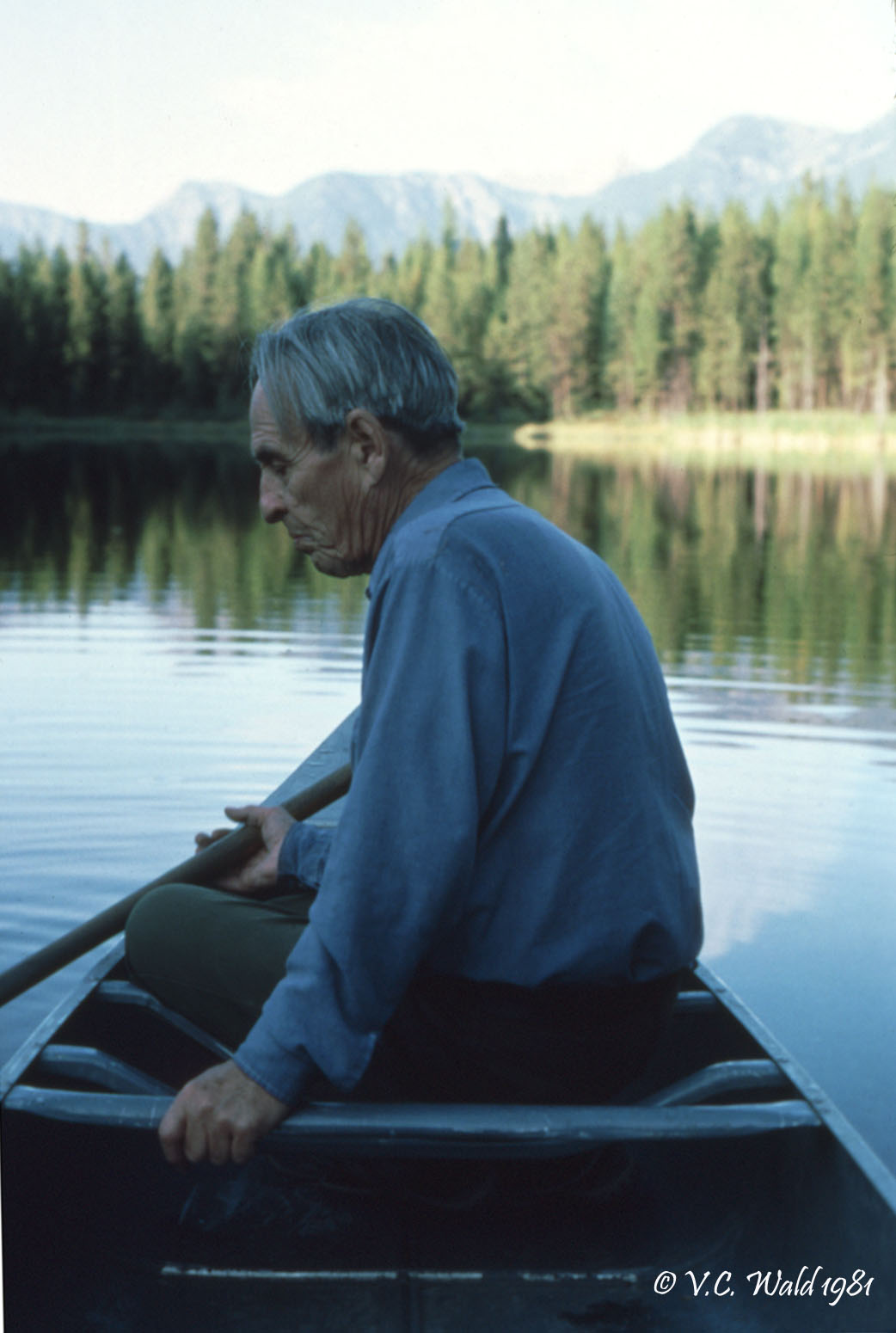
Although I’d always been an outdoorsy girl, I didn’t know much about the northern Rockies where the stories were set, so I was thrilled when along came the opportunity in 1981 to stop in at the family cabin on Seeley Lake, Montana where he spent his summers thinking, writing, and fishing.  Norman was a warm host, cooking us big mountain breakfasts, arranging a tour of the local sawmill, driving us far up logging roads into the mountains, and taking us on an unannounced visit to the cabin of this friend Bud Moore and his wife. Alas, the Moores were not in.  But their canoe was sitting by the shore, and Norman said to me, “let’s go for paddle” around the large beaver pond on the property. I was in the back, and my job was to steer. He sat in the bow, offering, as the man (albeit a 79-year old one), the power strokes to move the canoe ahead through the sweet afternoon light of the high mountain waters. Mind you, Norman was an accomplished mountain man, and was especially comfortable on water, be it a rushing trout stream or a serene tarn. Mind you, I was a citified young woman with armloads of camera equipment and boatloads of good will. But no experience or instinct handling a canoe. This made for a slightly riotous ride. When the frustrated Norman turned back to say, “Darlin’!” as he called me and all women he loved, and to unleash annotated comments on what I was doing wrong and how, unless I performed as instructed, we were going to capsize, I whipped the camera to my eye, and caught what has often been captioned as Norman Maclean in “a contemplative moment.” Thank God the canoe made it safely back to shore, my roll of film dry and intact, for the photo, which was first picked up by the University of Chicago Press to use on blurbs and promotional material for later editions of AARTI, has become iconic. 
Copyrighted and not to be used without permission.

More Norman Maclean stories, of which there are many but somehow are mostly about me, to come...

Norman Maclean MUST reads:
  • A River Runs Through It and Other Stories
  • Young Men and Fire: A True Story of the Mann Gulch Fire
  • The Norman Maclean Reader: Essays, Letters, and Other Writings by the Author of A River Runs Through It, edited by O. Allen Weltzein
Norman, I will always miss you.  

Friday, March 25, 2011

Report connects dots between arts education and future arts attendance

For those of you who might wonder what the organization I work for (NORC) does, here is an eye-opening example, my co-worker Nick Rabkin's  exploration of the reasons for the decline in arts patronage and participation in the United States in recent years:

Saturday, March 19, 2011

Together Again

Elizabeth (Betty) Horn, May 27, 1914-March 19, 2011
Rest in peace next to your beloved husband Joe. 
Your grandson KLK loved you very much too.

Friday, March 18, 2011

Japan

I have had a very hard time (who hasn't?) wrapping thoughts around the horrors in Japan over the last week or so. It's been difficult enough to understand what happened in Haiti, Chile, New Zealand (twice), Indonesia and Thailand. Of all of them, Japan, as the world's third largest economy and a very technologically advanced country, is easily the best prepared to recover economically.  Its one-two punches were bad enough without the third and probably most serious punch of nuclear meltdown and the looming potential for persistent environmental radiation. On top of that are the multiplying effects of massive long-term loss of power generating capacity; think of what that means for heating, cooling, industry, schools, hospitals, the arts and sciences...All of this on top of appalling loss of life. 
This is too much to internalize. To help me in my contemplation, I looked back to a notebook from my one and only visit to Japan, in September of 1983. This trip followed the second of two academic sojourns through the People's Republic of China with my then husband, a physicist much in demand as a speaker at Asian universities (see The China Diaries and They say, but she saw, for example). My first diary entry compared 1983 Japan to China, which was still, though increasingly rapidly, crawling out from under the end of Maoist government and the Cultural Revolution:
The contrast between Japan and China is almost incomparable. This is a country of things that work, of good design, of neatness and cleanness, of riches and abundance, of cleverness and great practicality. The international terminal of Narita [airport] is easy to cope with, highly automated, simplified, and every announcement, written or verbal, appears in English as well as Japanese. Except for our plethora of heavy luggage, getting from the airport by shuttle bus to the Keisei train for a one hour smooth-as-silk ride to Ueno Station, was really easy and amazingly convenient. 
The next day I wrote:
Japan continues to charm us with its convenience, cleanness, and the ease with which we can get around here. This morning we took the famous Bullet Train (Shin Kan Sen line) from Tokyo Station, with one two-minute stop at Nagura, to Kyoto.... The hotel here is classier [than the one in Tokyo], and thus our room is a little bigger. And our little red Hitachi color T.V. is free here—in Tokyo it was “coin-op.” We have the same kind of bathroom, a practical little metal box that looks like it came off a ship and was installed as a water-proof and fire-proof unit in one corner of our room. Here we are also each provided with a toothbrush in a sealed plastic container—also included is a tiny plastic tube of super minty “Happy White Dental Creme” with each. We also once again got a long kimono [printed cotton  yukata] each, plus one short men’s kimono meant to be used as a kind of Japanese equivalent to a British “smoking jacket.  
And in spite of yawning cultural and linguistic gulfs, I noted:
We’ve found that it is easy to communicate by gesture here. Sometimes in China we had more trouble doing so, but the Japanese always seem to understand what we are up to in no time.
Obviously, we were delighted. That night:
We had dinner at a little Japanese-style restaurant in the hotel. We decided to try real tempura, and while waiting for our entrees were brought a bowl of a clear and good-smelling liquid with it. In Chicago tempura is customarily served with a clear soup [miso] and a small bowl of dark-colored strongly flavored salty dipping sauce. Since we weren’t sure whether this lovely liquid was soup or sauce, I volunteered to sip a little while my husband, who was sitting in clear view of the waitresses standing in front of the sushi bar, kept a watch to see if anyone was looking at the American hicks. I sipped a little and (sincerely) declared it to be a delicious soup. Whereupon Bob picked up his bowl to take a gulp—he was instantly spotted by a cook and the waitresses, one of whom came over, amidst her colleagues’ obviously stifled giggles, to straighten us out—the liquid, she demonstrated, was for dipping, not for drinking! It was very funny. In China nobody ever has bad manners, but here we feel like we’re all elbows half the time. 
It was a beautiful country of happy people. What will it be now?