I receive some very nice comments and invite you to add yours and to enjoy the remarks of others. Thank you.
*************************************
All photographs are copyrighted by me unless otherwise noted. Please contact me (vcwald at yahoo dot com) if you would like to use one or more of them.
Most images will enlarge if you click on them.
Bear-watching in Churchill, Manitoba is different from bear-watching in the rest of the world. Although there are places where the concentration of bears is even higher (on a similarly seasonal basis) such as Brooks Falls in Alaska's Katmai National Park during the salmon runs, bears and people are physically segregated and bears, focused on feeding, pay little attention to human activity. But ever since the early 1970s when Yellowstone National Park banned the feeding of bears, there is no place else like Churchill that affords such intimate observation of wild bears.
The little town of Churchill and close surrounds is where hundreds of polar bears congregate from mid-October to mid- or late November each year, waiting for Hudson Bay to freeze over so they can end their months-long fast on land and get out on the ice to hunt seals. The resulting very high density of bears increases the chance to 100% that bears will be seen over a week-long visit. That contrasts strongly with a similar amount of time spent in Yellowstone and Grand Teton National Parks in early June, when bears are seeking food at altitudes that humans regularly occupy. Although the chance of spotting a grizzly or back bear in the greater Yellowstone area in early summer is higher than at any other time of the year, it is also possible to spend 7 days looking, only to see not one bear. Churchill also once unabashedly institutionalized bear-feeding, and it still goes on in a small-scale, off-line way. But bear-watching in Churchill is virtually bait-free these days, so it is remarkable that the bears appear to be so curious about the presence of humans on their landscape. This sequence of photos was taken from the safety of our transport, a noisy old school bus, along a side road near the Bay. When this bear, about 40 or 50 yards off the road, noticed the bus grinding slowly along the snowy dirt road, it was startled but rather than fleeing, it froze. Jim Halfpenny, our guide, inched the bus forward and then turned off the engine, motioning to our excited group to remain hushed.
It then proceeded to walk cautiously toward us, stopping every few feet to monitor the situation. Maybe it was just a sleepy bear, but yawning is also a symptom of stress in polar bears.
The closer it got, the more confident it became.
By this point it was apparent that it had a black smudge under its right ear, and within the ear, a small white plastic identification button. That the smudge was still visible - presumably a signal to wildlife managers or scientists that the bear was tagged - suggests that its experience of being darted with a tranquilizer and physically handled by humans was recent.
Nonetheless its curiosity prevailed, and it kept walking toward us.
It readily made eye contact with me. Or with the big black round eye that is the business-end of my camera lens.
Polar bear claws, adapted for dealing with ice and snow: it is apparent from the angle of this shot that the bear was almost directly below my perch at the window of the bus.
Nearly face-to-face, from the safety of an old school bus: was this young bear's curiosity satisfied?
Jim started the engine as it became apparent that this healthy little bear - probably a young male - was contemplating rising on his hind legs for a better look inside the bus. The bear skedaddled immediately, and no one was the worse for the wear.
Churchill polar bears are also very much attracted to larger tundra vehicles. Once out on the tundra, by far the best place to see bears is anywhere within a couple of hundred yards around a tundra lodge, of which there are two (Great White Bear Adventures', and Frontiers North Adventures') parked on the tundra for the 4 to 5 week duration of the season. Almost all of our better 2011 bear photos were taken at GWB's lodge. This year we circumnavigated FNA's Tundra Buggy Lodge very profitably in terms of photo opportunities.
Why do they like these structures? There are several possibilities: lodge kitchens produce three meals a day, so it might be the exhausted food odors. Or, the fact that there are people in them who look through open windows and stand on viewing platforms and talk at all hours might make them intriguing to a bear that has nothing else to do but investigate human activities. They are so large, conceivably they provide a little shelter from the wind. This young bear found the lodge undercarriage to have potential as a toy:
The relative age of a polar bear can be determined by the color of its tongue. While this was not a cub, it was a playful younger bear, small in stature, and with a still pinkish tongue. As they age the tongue becomes more gray and eventually, in an older bear, nearly black in color. Note the huge buggy tire behind the bear.
Mobile "day-trip" buggies come and go, bringing more interesting sights, sounds and smells. This bear sat right under my tundra buggy window. The orangey stain on its feet was from digging in kelp washed up on the beach. Unfortunately we weren't interesting enough for it to rise up on its hind legs for a closer look (at each other).
It wandered away off to a buggy parked near-by where there were people outside on the viewing platform. Now that's so much more appealing to a bear than people inside the white box!
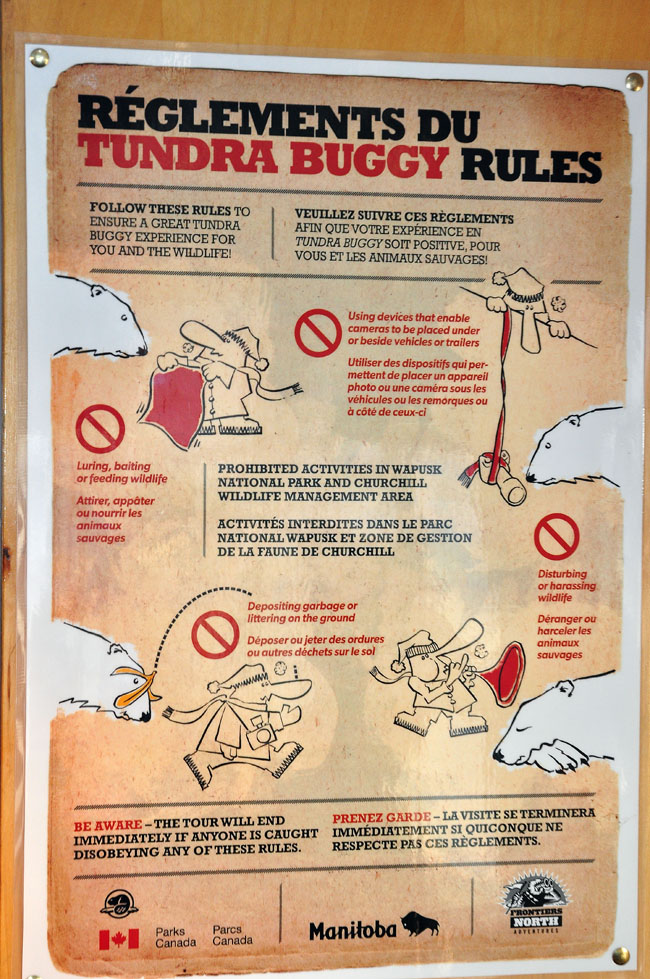
We saw this behavior, which is in fact stereotypical, repeated at another buggy soon after kelp bear went on its way. There is a reason the buggies are as high off the ground as they are. Occupants are strongly warned about not allowing scarves or camera straps or hands to dangle...
In
what other wild setting do bears approach people, safe in vehicles, for such close-up looks at one another? Why do the bears
do it? Their chances of scoring food are very, very small, but in 2011 we
watched a bear nestled under a tundra lodge viewing platform consume a ball cap that had blown into range off of
someone's head. I wonder if it assuaged his hunger at all?
Canadian Eskimo dog puppy, typical of his breed, tethered outside of the Arctic Trading Company, Churchill, Manitoba
The North Country is dog country, and working dog country at that. The archaeological and historical records show that native peoples of the circum-arctic region - Canada, the U.S. (Alaska), Russia, Norway, Greenland - have used dogs as beasts of burden, to pull sleds, and as vital collaborators in the hunt (bears, seals, muskox) for at least two millennia. Their ancestors are known to have brought the progenitors of the modern arctic dogs with them on their migrations from Asia to North America thousands of years ago.
Americans are familiar with the most refined breeds of sled dogs in which specific features such as size and weight, stance, fur type, coloration, and conformation, consistently meet defined standards. These include the Siberian husky and the Alaskan malamute, both of which are most commonly kept as house pets, although they can and do work in harness as well. But as usual, what we think we know about something, we don't really. On this November trip we received an introductory education to the complex world of sled (or sledge) dogs, as understood by the people of Churchill. No visit to Churchill is complete without it.
Miniature carved caribou antler dog musher, sled and team, Eskimo Museum, Churchill, MB. The card says, "Man with Dog Team: The driver indicated direction by calling to the lead dog. He emitted various sounds to encourage the group. A whip kept the lead dog in line or alerted the tired dog which would stop at the slightest provocation. Sometimes tufts of fur or skin on top of the tail or body would be torn off and the dog would yelp. The whip was rolled by being brought quickly back and then forward suddenly with a quick movement."
There are two major "camps" of sled dog breeders/ keepers in Churchill. The first is comprised of traditional mushers, that is, people who hitch dogs to sleds for transportation, recreation, and for competition, such as that spectacular test of canine and hominid endurance, Alaska's nearly 1,050 mile Iditarod race, or, in Churchill's case, the 220 mile Hudson Bay Quest. In Churchill, we were treated to a visit to Wapusk Adventures, hosted by its bigger-than-life founder and owner, Dave Daley. Musher Daley clearly is committed to educating visitors to the world of Canadian sled dogs, which, as far as I can tell, is a catch-all term that refers to dogs that are long-legged, lean running machines. Although they live their lives outdoors (except for the shelter of plywood houses, door lee to the wind, with a pile of insulating straw bedding), they are carefully socialized to people. And Dave Daley makes sure his dogs know he is their alpha, their leader, their security, their feeder, and their source of joy in life. Daley keeps a kennel of maybe 40 dogs, and breeds them to produce only the occasional litter to assure that as his older dogs retire their replacements are trained, conditioned and ready to go. Here are some pups from the 2012 litter, kenneled at the visitor center, eager and available for pats and "conversation" with friends and strangers alike:
This is where the adults spend their non-working hours:
But as soon as the tourist bus pulls up, all are on alert. They are hoping, hope against hope, that it will be their turn to pull a musher (driver) and two riders for an all-too-quick spin through the forest path. When the harnesses come out, they start to bark and yowl, begging to be chosen for the job!
That wide mouth and show of teeth and the loud barks and yelps you can imagine to mean, "I can't wait to get running!" This particular dog was so funny, with his little boots. He must have been sore of foot, but a back bootie fell off early in the game and he ran all his circuits with just three, with no hint of lameness.
I love the guy in the back there, with so much enthusiasm that as long as he can't move forward, he will move upward!
Here's what the rig looks like: one tourist seated, one standing, and a spot in back for the musher to stand (not visible in this photo):
And they're off! It's amply clear the dogs live for this moment. The sensation is that they reach top speed - let's say, 3 to 4 miles per hour - as soon as the musher lets off the brake. Then the only sound is the sled's runners on the hard-packed snow and the occasional soft patting of the dogs' feet (the camera's microphone exaggerates the sound of the wind). It's very interesting to ride behind them and see how each animal has its distinct gait, pull-strength, and level of concentration - that's how a good musher like Dave Daley knows how to position his dogs - lead, swing dog, wheel dog, etc. - for the best speed, control, and peaceful achievement of distance.
And here they come, having completed a bracing turn through the woods with their thrilled guests in tow. The cold was unnoticeable in that late afternoon light and peerless fresh air, steadily sailing along behind these fulfilled athletes. Dog-sledding now ranks high on my list of life's great pleasures.
This is Venus, of Wapusk Adventures. Isn't she lovely, with her ice blue eyes and sexy black "eye-liner"? Note, however, that her build, typical of a Canadian sled dog, is not that of a husky or malamute, nor does she have the thick fur expected of an animal that works and plays in the extreme cold of the Arctic.
The Canadian Eskimo dog, unlike the more common
Canadian sled dogs that look like their genetic heritage might be a bit
helter-skelter, is recognized by the Canadian Kennel Club as an endangered breed.
The long history of this rugged indigenous dog, so closely intertwined with that of the
Inuit peoples, came perilously close to an end in the 1970's as the
Inuit adopted mechanized means of transport like snow-mobiles and ATVs,
removing the motivation to keep dogs - the
Canadian Eskimo's metabolism is that of a pure carnivore, and in that sense it expensively competes with people for sources of quality protein and fat. Various
organizations and individuals around Canada still breed the dog to keep it from
the brink of extinction, and among them, the most well-known and controversial by
far is Churchill's Brian Ladoon. Ladoon virtually single-handedly represents
the second "camp" of dog breeders in Churchill.
Ladoon's
dogs are particularly famous because they are "tied down" - that is,
each on a 15 or so foot chain tethered to long cable anchored in the ground,
Inuit-style - in prime polar bear country. Photographer par excellence Norbert
Rosing happened to witness and document the apparently remarkable interactions
between the restrained dogs and bears awaiting freeze-up on Hudson Bay. Rosing's images show what, to all appearances, is affectionate play among bears and dogs, and the behavior has
been observed regularly since. (Follow the link to see Rosing's photos; the images below are all mine.) As far as I can
determine, from a scientific standpoint the behavior remains poorly
understood.
Not everyone believes these interactions are so charmingly innocent, however. Ladoon, whose very large pack of dogs has to be fed meat, profits from charging delighted visitors to enter the dog's unfenced compound. He has often been accused of baiting the bears by over-feeding the dogs, thus attracting more visitors hoping to see the bears romping and snuggling with their canine pals. The leftover food would of course attract the fasting bears, which, apparently satisfied with the meat, do not kill/eat the dogs. At least they don't usually kill the dogs; in fact, several fatal bear-dog interactions, whether intentional or accidental on the part of the bears, have been documented to occur each year. Ladoon blames this on the interference of wildlife managers that have removed the bears because of their habituation, which in turn makes room for aggressive bears to enter the area and kill the dogs.
Unlike the sled dogs of Wapusk Adventures whose plywood houses are nestled in the windbreak of the forest, and where visitation by bears is vigorously discouraged, Ladoon's Inuit-style tie-down is on a highly exposed acre or two of tundra with no shelter what-so-ever, winter, spring, summer or fall. The tie-down is no where near Ladoon's home, nor that of anyone else, for that matter. What happens to the dogs out there happens, almost always, with no opportunity for human intervention.
This polar
bear, easily identified by the pattern of scars on his old face, is known as
"Dancer" and in spite of the defensive response from the dogs, never
approached them or otherwise behaved threateningly as we watched for over half
an hour one morning.
Even if Ladoon's feeding practice is not in fact attracting polar bears, there is plenty more basis for concern. The Inuit didn't invite their dogs into their igloos when the daily highs fell below-zero and stayed there all winter long; hunkered down in the snow, the dogs were sufficiently protected by their fur and body fat, and Ladoon's dogs apparently are too. But
nobody talks to winter tourists about what happens when the temperature
stays above freezing, as it does in the subarctic summers. While in the winter, dog excrement quickly freezes and is in effect vaporized by the friction of the dogs' chains dragging across it, in summer, it seems likely the feces pile up and particularly attract the intense irruptions of biting flies the
tundra is famous for. Although each chained animal has a circle of about 30 feet in which to move around, it cannot be healthy for the dogs to be restrained in proximity to excrement, nor can it be humane to set up a situation in which they cannot escape hoards of biting insects.
The internet is more than full of opinions about Ladoon: he's a saint who is saving a unique indigenous working dog, caring for them the way they were bred to live, he is misdirected and self-glorifying at the expense of his animals... But in my mind, what is incontestably egregious is not that the dogs are exposed to the elements (by far the most common complaint) - after all, they appear healthy and show a lively response to the presence of visitors - and bears - but the fact that they are never harnessed to sled. They are born and bred to work, but as far as I could determine, Ladoon's dogs never get beyond the small circles to which they are chained. This seems to me to be the ultimate justification for revoking Ladoon's license - which, by the way, is not official, but at the behest of Churchill's leadership, which doubtless has its reasons for supporting tourist attractions and local business. I was also given to understand that Ladoon does not readily give or sell his dogs to others who might harness and run them - it appears that he in essence hoards them in the name of saving the breed.
Adult dogs at Ladoon's tie-down on the tundra
Canadian Eskimo dog puppy tethered in front of a shop in town where tourists can pat and contribute to the socialization of the pups
Carved baleen silhouette, Eskimo Museum, Churchill, probably dating from the 1940s or '50s
Traditional Inuit seal-hunting vignette in tufted caribou fur by Churchillian Myrtle Demeulles
If you
know, or feel, differently about Ladoon's or Daley's dogs, kindly comment, as
my opinions are formed on the basis of limited personal experience and a great
deal of third-party opinion, which is consistent only in that it is
inconsistent.




-WapuskAdventuresDSC_0476.jpg)


