Showing posts with label Grand Teton National Park. Show all posts

Sunday, May 21, 2017

Grizzly 399 lives on!

The now 21-year old beloved Grand Teton National Park grizzly mother, known by her wildlife management number "399" has been seen again in this, the spring of 2017, with two new cubs. Evidently after her lone 2016 cub was killed by a car, she became receptive and crossed paths with a male grizzly in time to be impregnated again. Her longevity and her fecundity are remarkable. Fortunately, the Park Service is becoming more protective of her and her successive offspring. I understand the road through the area she has long frequented has been closed to auto and foot traffic to help give them safety and privacy to just be wild bears. Perhaps she'll lead the kids closer to the main road - not good for bears but good for my soul to see and maybe photograph them - while we're there next month.

Meanwhile, Yellowstone National Park has recently seen an increasing number of "roadside" female bears, including three or four mother grizzlies and cubs born either this year or last year. The yearlings will spend one more summer and winter with their mothers before being pushed away to pursue lives of their own and to allow their mothers to breed again.

Roadside bears - in theory, mother bears raise their cubs in proximity to human activity to discourage the greatest threat to their babies, male bears that kill them in the expectation that the mother will come into heat again (as did 399 last summer after "Snowy" died) - are a hazard to people, cars, and themselves. This is Yellowstone grizzly bear number "815" who, after allowing a very sizable crowd to watch her and her year-old cub, came down from the rise where they had been napping to a pullout where cars were parked. Most people were out of their cars and some distance away, but some were close (I was not; this photo was taken with a 600 mm telephoto lens) and trying to get pictures with phone cameras and iPads, none of which have sufficient telephoto capability to assure a decent photo from a safe distance. Fortunately 815 just rooted around a bit, then led her cub past the pullout to where there were almost no pedestrians and all traffic was stopped to safely cross the road.

815's cub, born in 2016.

Wednesday, July 27, 2016

Legend, Interrupted


The female grizzly bear known by her wildlife management number as "399" has raised family after family of cubs near the roadside at the northern end of Grand Teton National Park since her first set of triplets in 2006. The rate of survival of her cubs has been extremely low; some disappear between their first and second years due to natural, but otherwise unknown circumstances (as is very common in grizzly bears); some have reached liberated adult status (shortly after emerging from the den following the second winter with their mother and sibs) but then gone on to be shot by hunters, hit by cars, or “humanely removed” (euthanized) after one too many encounters with human spaces. One of them, "610," is still in the area and bearing litters of her own.  She was one of the three cubs born in 2006.
399 herself is 20 years old, which is up there for a wild grizzly; her first litter (preceding 2006) consisted of one cub, then each subsequent litter was three cubs. This year when there was concern that she might not appear at all, or that she might no longer be fertile, she brought joy to everyone by emerging from the den with one light-colored baby (cub of the year, or COY) that was dubbed "Snowy" because of its pale coloration. 
Each year 399 has had triplets, starting in 2006 I've been fortunate enough to see and photograph them. Sometimes conditions for photography were very poor, but I still documented the sighting.
This year I saw 399 and Snowy only once, briefly, at many yards distant and got off one shot each of them standing in the sage. 
 Exactly five days after these two photos were captured, Snowy was mowed down by a vehicle and killed. The circumstances are not known because the driver did not report the incident as is required. He or she may not have known what it was they hit, especially if the cub ran under the wheels rather than in front of the vehicle.
 Regardless of how it transported, this loss caused great sorrow to me and to 399's thousands of fans world-wide. And was yet another blow to maintaining the fragile population of grizzly bears in the Greater Yellowstone Ecosystem.

Sunday, June 22, 2014

Grizzly 399 Shares Her 2014 Secrets

Three weeks ago we returned from ten marvelous, as always, days in our favorite part of the world, Yellowstone and Grand Teton National Parks. 2014's marvels included hikes to fascinating locales new to us plus a few favorite places we haven't checked on in a while, our first (at long last) river otter sighting, catching up with beloved friends, and a photo ops galore. Premier among the wildlife-sightings was our favorite grizzly bear 399, known to her fans as Queen, or Lady, of the Tetons. She is the exceptionally fecund bear that likes to bring up her young broods near the roads in the 5-1/2 mile region spanning two visitor areas, Colter Bay and Jackson Lake. Last year we relished watching her three new triplets play along a side-road just far enough away to be considered safe. Indeed, 399 was wholly focused on eating grasses, roots, flowers, insects and worms while the kids alternately nibbled and grubbed and cavorted, all ignoring their thrilled paparazzi.

We got up early on our third morning to go look for wildlife, which is really just code for "look for bears." Only a mile or two down the main road we could see the indubitable sign of wildlife activity ahead: many dozens of cars parked along both the shoulders and people all running in the same direction, more or less loaded down with camera gear. Who should be eating and playing along the south side of the road but our most familiar and favorite grizzly, 399 and two year-old cubs. This how we learned that one of the three had not survived the winter. Big fierce muscular grizzlies, especially young ones, it turns out, are in fact very fragile and at high risk for death before they are sufficiently mature to reproduce. It's not known what happened to the third cub, though there is speculation that before the bears even denned for the winter it was separated from its mother. In their first and second years, grizzly cubs cannot survive alone, especially as winter approaches.  Although they can feed themselves plant and insect material and eat from carcases (and, alas, human food supplies and garbage, though this no longer happens in Yellowstone/Tetons) they come across, they still need their mother to hunt meat for them and occasionally, to nurse them. In this photo, one of 399's axillary mammaries is clearly visible  behind her left foreleg. Note her nice grizzly-style claws, too.
Here she is with one of her year-old cubs, for size comparison. This nose-down posture is how we see bears most of the time as they eat-eat-eat all summer to assure reserves to make it through another winter.
399 was huffing (inaudibly to us, but we could see it in her expression and movements) at the second cub, about 50 feet behind this beautiful mirror of a snow-melt puddle, to "come along now!" The other cub was quite busy overturning rocks and pieces of wood to find tasty ants and worms. To me it seems unlikely that such large animals can satisfy a big portion of their caloric needs by eating plants and small invertebrates, but they do. 
Adding to the romance of watching these bears is the stunning scenic backdrop of the Grand Teton mountain range. Her characteristic shoulder hump is very evident in this shot.
The rangers, like this guy in the Smokey the Bear hat and reflective vest, work very hard all summer to protect not only park visitors but these habituated bears that really are not skittish enough around people. I call this photo "Baby Bear Mayhem" as one of the cubs makes its way across the road and stops to look at the paparazzi. All traffic is stopped of course. The folks on the left side of that tour bus got a great look at the cub. Note the license plate on the big black SUV! Many people come to the park purely to watch and photograph bears.
The cubs made it across safely but one continued to evidence curiosity about its watchers. Frankly, it would be much better if it were shyer.
Finally Mother Bear 399 found herself reacting to the passing of an over-sized camper.
But then everyone went back to priority bear business, namely, cashing in on the nutritious green grasses and flowers before they naturally dry out as the season goes on.

People often ask how close I was when I take these kinds of pictures. Here's a wide angle on this scene. Although it looks like there are no longer a lot of people around, in fact the rangers do not allow people to pull over near the bears, so as the family gradually migrated from one side of the road to to the other, to the pond, and along the grassy hill, the rangers regularly barked orders to the watchers to back up, and eventually, to move their cars well down the road as well. In this picture I am at the vanguard of a large crowd of photographers (many blessed with much better glass than I) with maybe 50 or 70  cars behind us.
This was without a doubt the most rewarding time spent with 399 and her many cubs since I first spotted them in 2006. This year we were lucky to see the family twice more before we left the park, though never as clearly nor for such a prolonged and fruitful bear-watching session.  The rangers were certainly harried, and many park visitors contentious about not being allowed to just stop and get out of their cars, especially along a crowded intersection later in the day such that there was a great deal more traffic to contend with. It concerns me that the bears are utterly nonchalant about traffic, and so many people are either oblivious to their need for distance or alternately, not interested in seeing the bears and aggressively trying to get past the "mayhem," both set-ups for bear and/or people disasters.

Sunday, September 8, 2013

The Built Environment: Parkitecture Grand Teton National Park

I've blogged on the subject of "parkitecture" both in the context of founding mother "parkitect" Mary Colter, and the wonderful Parkitecture Flickr group (now up to 192 members and 1,982 exemplary photos I might add) to which people post their images of  endearing man-made structures -- historic, pre-historic, and contemporary -- that add to the aesthetics, function,  and appeal of our national (and other) parks and public spaces.

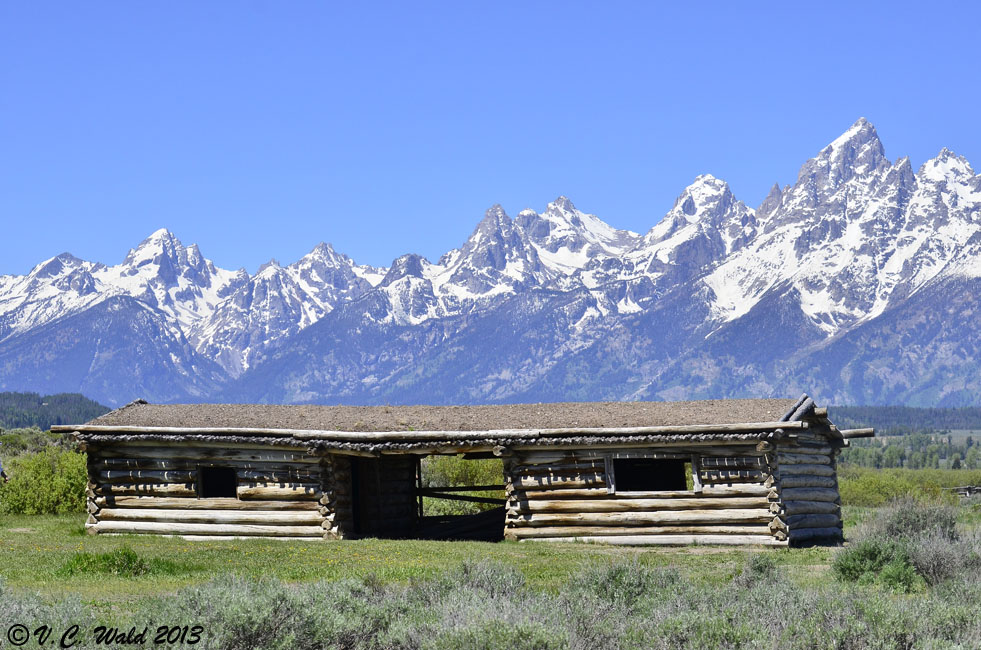
Yellowstone and Grand Teton National Parks are both especially replete with such buildings and structures. This year, for example, we stopped by the historic Cunningham Cabin in GTNP: 
The Cunninghams settled in the area in the 1880s, toughing out baking summers and long, cold and snowy winters on the sage flats of Jackson Hole; the soil is poor, and water unreliable. Indeed it was drought that finally did in their enterprise.  Now all that remains of the homestead ranch is this "double pen" style cabin, but oh my, without question, the view is still beyond compare.

Among GTNP's many other very old structures is the White Grass Dude Ranch, a mile or two up the stony, rutted, alternately dusty and gummy-mud road to Death Canyon trailhead. I first came upon White Grass in 2006, when the buildings were barely still upright and the marmots made homes in the cabins, emerging through holes in the roofs to safely check on interlopers (me).
That day I was the only person wandering around the stunningly beautiful "park" (wide open flat area), and there was no information, either on site or on the internet, to clue me in as to what I'd stumbled upon. Flash forward to 2013, now with an informative sign near the side of the road and heartening progress towards preservation:
A homestead of about the same era as Cunningham's, White Grass Ranch first accommodated paying guests -- tourists to be sure -- in 1919. Though sold to the National Park Service in 1956, its owner at the time continued to operate it for dudes until 1985. Mouldering and neglected for the next 20 years, finally now, as noted on the National Park Service's Grand Teton National Park website, "...the National Park Service, National Trust [for Historic Preservation], and the Western Center for Historic Preservation seek to rehabilitate not only the thirteen remaining cabins, but the cultural landscape as well." But it's even better than that: the prime mover in the project, the Western Center for Historic Preservation, is "...an education and resource center dedicated to the preservation and maintenance of cultural resources in our Western national parks. The center promotes leadership in preservation education and skills development with government partners, non-profits and educational institutions committed to the same goals." The project at White Grass is a working laboratory that trains volunteers and National Park Service personnel in the conservation and restoration of historic structures. Once completed (2016, if all goes well) it will continue to be used as a training facility for what I consider to be one of the most worthy of possible goals of the National Park Service, the preservation and rehabilitation of historic and rustic buildings. Next year when we go back I'll have updates.

Grand Teton Park also has several contemporary, and equally significant structures; I've previously blogged about the newest, the Laurance S. Rockefeller Preserve Center.  Notable among other very recent GTNP builds is the Craig Thomas Discovery and Visitor Center at Moose, Wyoming,  which opened just inside the main entrance to the park in 2007.  Designed by architectural firm of Bohlin, Cywinski Jackson, it represents quintessential 21st century parkitecture in its visually successful resonance with its natural the environment, the backdrop of the Grand Teton range. This is the inspiration the designers had to work with, as viewed from the visitor center parking lot:
And how they echoed it in the roof-line from the Japanese-style-like front entrance:
 And how it looks from the opposite site (mountains to my back):
And what visitors see from the inside as they stroll through the educational exhibits on the geology, wildlife, and cultural history of Grand Teton National Park:

Sunday, September 1, 2013

Man-made wonders: Jackson Hole Aerial Tram

Not only are the natural wonders of the greater Yellowstone area feasts for the heart and soul, but so   are a remarkable number of the man-made objects and structures. For the first time in many years, this June KLK and I picked an opportune day to ride the Jackson Hole Aerial Tram from Teton Village (a metastatic ski resort of expensive condos, romantic luxury homes, good and not-so-good restaurants, spas, outdoor sports vendors of all kinds, and an ever-enlarging cement parking lot blotting that little spot in Bridger-Teton National Forest immediately south of Grand Teton National Park) to the top of North Peak of Rendezvous Mountain. It had been 7 or 8 years since we last rode the original tram, which opened in 1965 to serve skiers and snow boarders in the winter and hikers and sightseers in the summer, but we remembered the experience of being gently lifted 4,139 vertical feet above Jackson Hole as thrilling.
Original Jackson Hole Aerial tram, 2005
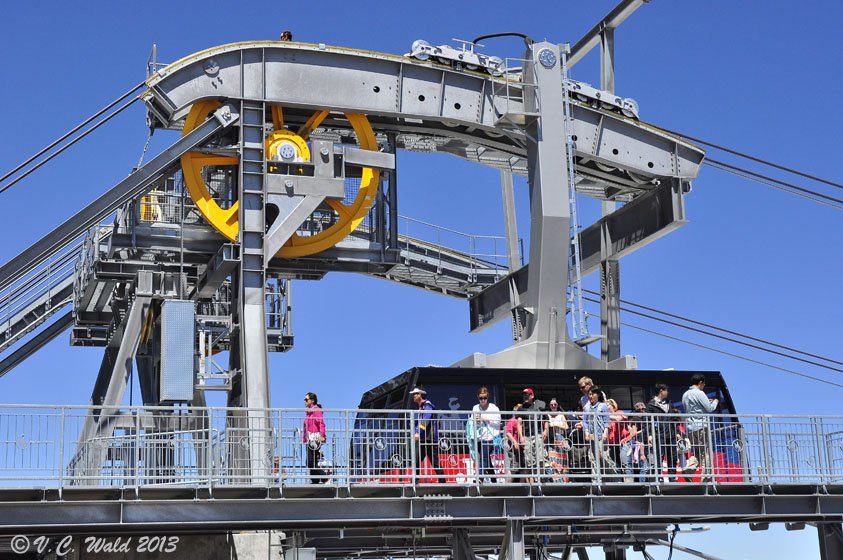
The old tram, with its small capacity and ever-increasing maintenance needs, was replaced in 2008 by a beautiful 100-person cabin and new supporting infrastructure, bottom-to-top (here's a fascinating blog about the process). This was our first ride on the new tram, the mechanics of which were built by the Swiss (who else?) company,Doppelmayr CTEC.  This is what the new workings look like at the base:
Now I know how it feels to be inside a somewhat oversized Swiss watch.
Waiting our turn.
Leaving the resort below...a corner of Teton Village in the foreground, a bit of the flats of Jackson Hole in the middle, and the Gros Ventre Range in the distance. 
It's a long way up to 10,450 feet. Because there are year-round services at the top, there is road (not open to public vehicles) that makes a great 7-mile hiking trail. There are foot races up, but we, being normal, have ridden the tram up and walked down.
Picture 100 happy sardines -- I mean happy skiers and their skis and poles and snow boards and bulky ski suits -- crammed in there. Better than the old 50-person tram, to be sure. We're above the treeline, ascending more vertically along the last stretch and up close and personal with Corbet's Couloir, a sheer rock face that in winter becomes a suicide drop on every hot-dog skier's do-or-die list.
Corbet's Couloir. Aren't you inspired to ski right off that cliff?
There's another Swiss watch at the top.
And a fancy communications get-up on the roof of Corbet's Cabin. 
The angle of view is so wide it's a little hard to pick out from the ledger which peak is which, but to be sure, the pointy one touching the sky is Grand Teton.

Some serious geologic uplift, subsidence, and at one time, glaciation going on, too. Click on the photo to enlarge for detail.
Here's KLK at Corbet's Cabin (the building with the prickly communications gear on top), best place on earth to score a hot cocoa with a view. Also not a bad place to have a hot dog and chips, use the restroom, get warm on a cold day (which this was not; on a windless, sunny summer day it's nearly shirtsleeves -- with sunscreen -- up there). 
That flat-topped peak is the rim of Cody Bowl, where you can hike or ski. When the wind suddenly started to gust aloft, we reluctantly rode back down, below treeline here now. People often report seeing wildlife -- moose, bears, marmots, soaring raptors, apparently unperturbed by the big red box sliding up and down overhead -- in this area. This trip we zoomed past a mule deer doe, alas, too quickly to get a photo.

I am not a religious person, but there is something about being at the top of a tall mountain that makes me feel close to The Divine.
 
 Grand Teton peak viewed from Rendezvous.


Sunday, August 25, 2013

Just Life, and a Good One at That: Photo Essay

From my last couple of posts a reader might be inclined to avoid Yellowstone and Grand Teton National Parks as depressing places good only for witnessing that Great Bitch Mother Nature wreak her havoc. Not so, let me assure you! They are in fact supreme places for lifting the spirits, making the heart sing, and, mostly, for being constantly awed by Nature at her best. Here are some examples, in no particular order. I'll keep commentary to a minimum so you can judge for yourself.
Early morning view, Grand Teton range
Newborn elk calf, Mammoth Hot springs, just learning to stand and nurse. The elk find safety from predators to be a fair exchange for the presence of humans, and their vehicles, and their buildings.
 The hike to Hidden Falls, Grand Teton National Park.
Lone Star geyser is an easily accessible back-country geyser in Yellowstone. The cone itself is about 12 feet high, and in full eruption reaches 30 to 40 feet and lasts half an hour. It's one of very few geysers that can be safely approached closely enough to fully sense the power of the eruption.
The trail to Lone Star geyser follows the Firehole River for a couple of miles.The Firehole is a great trout stream.
Bacteria and algae capable of thriving in extremely hot, very acidic or very basic, highly mineralized conditions in Yellowstone's thermal features - this one is the edge of Black Pool in West Thumb Geyser Basin - are responsible for the glorious colors.
Speaking of glorious color, these are the Red Hills, a little east of Grand Teton National Park in the Gros Ventre Wilderness; the red color comes from iron. The lake is Lower Slide Lake, formed by a sudden massive landslide that dammed the Gros Ventre River in 1925.
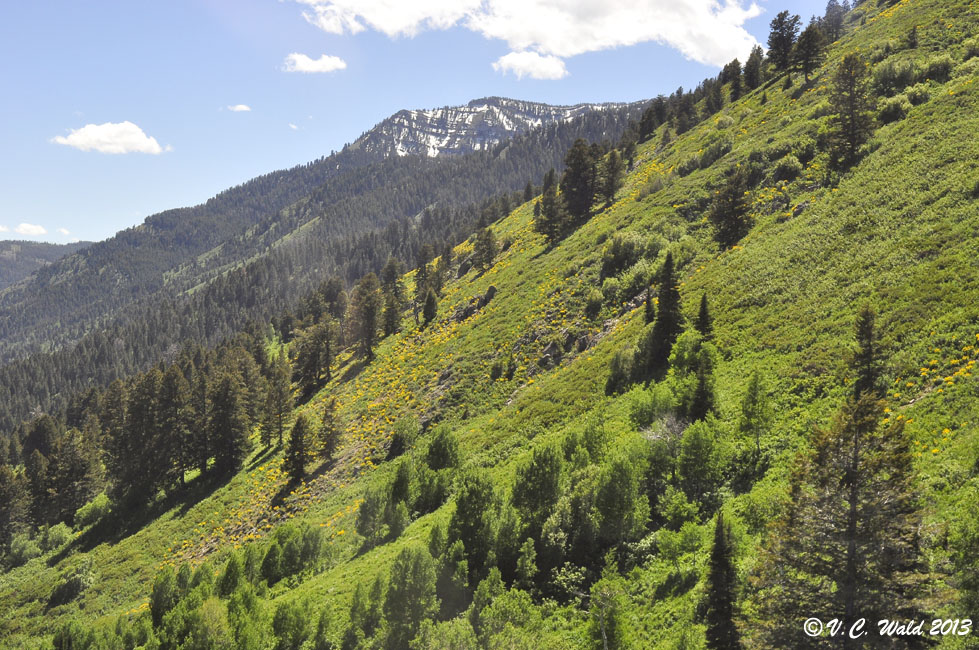
 Arrowleaf balsamroot all abloom in June, Grand Teton National Park.
Trout Lake, Yellowstone National Park. We looked for otters but saw only the fish they feed on, the Yellowstone Cutthroat Trout (classified as a threatened species), gathering near the inlet in preparation for spawning.
The female alpha wolf of Yellowstone's Lamar Canyon pack, known as "Middle Gray" hauling brisket of elk back to her pups.
Bison calves practicing being bison.
 
The Grand Teton Range, beauty beyond compare.

All photos from June 2013.