Sunday, February 23, 2014

Spring is on the way. Alas.

Some people think I'm a nutcase (KLK's exact words), but I in fact love winter, and with at least two distinct Polar vortexes this winter, Chicago, from late December until the end of last week, had its first real winter in years. It's been a quarter century or more, since we had sustained temperatures below freezing, day on day, week on week. We also had significant snow fall, which of course repeatedly messed up transportation -- bus schedules were simply abandoned in face of hopelessly piled snow and cars parked willy-nilly along the city streets -- and it made a total mess out of my car, which looks like a giant chunk of bacalao.  I thought all this crazy stuff fun.
It's all waning now,  with longer days signalling the earth's gradual tilt to spring. At least KLK and I found a most entertaining way to take advantage of the cold weather while it lasted. All along the upper Mississippi and many of its larger tributaries, instead of migrating, American bald eagles wait out the lean months below locks and dams, which keep the water from freezing over so they can continue to feed on fish. In late January, at the Army Corps of Engineers lock and dam at Utica, and across the Illinois River at Starved Rock State Park, the Illinois Audubon Society hosted Bald Eagle Watch. This view is from above the lock and dam. Impressive ice coverage!
Below the dam is a different story, at least for a few hundred yards downstream. This is where the eagles soar:
Unfortunately for the photographer (me), the width of the river made it difficult to get good pictures, just because of the distance to most of the action. But here's zoom in on an eagle with a good-sized fish in its talons:
Looks like a satisfying meal for a 10 or 12 lb bird, but alas, it's a good thing my camera was on continuous shooting, because a wing beat or two later this happened:
Life's hard in the winter, even around the dams. Maybe not so much for the gull, who was apparently anticipating this possibility. Who knows whether the fish lived another day.
But I did catch one magnificent bird on the wing from the vantage of a high bluff over the river:
The trees on Plum Island, an Audubon island sanctuary in the middle of the river, were amazingly full of roosting eagles. Because of the distance and angle of the light coming through the trees, I have no good photos to share, but these Canada geese also availed themselves of the safe harbor, resting on the ice in numbers.
And this great blue heron also enjoyed the sustenance of the open river.
Littler birds, like this dark-eyed junco provided entertainment at suet and seed feeders in the state park:
 And this very cute tufted titmouse:
And the white-breasted nuthatch at the suet:
And the female down woodpecker, also working the suet:
Here's a nice bald eagle caught by the waning sunshine as it flies past Starved Rock.
The story of our weekend adventures is to be continued...

Friday, February 14, 2014

Unhappy Valentine's Day

1. Background
Red Hots! Cinnamon candy, I've always associated them with Valentine's Day.
Red Hots! Shiny-red, pretty, sweet, and 7/16ths of an inch across!
Tylenol! Shiny-red, pretty, sweet*, and and 7/16ths of an inch across!

2. The Problem
How is a little kid to discern the difference? Like Red Hots, the adult-strength pain pills don't come in a strongly child-proof container, just line up the arrows and flip off the cap:
Awfully easy for a curious, dexterous child to investigate.
Could they be easier to confuse?

Given how toxic the slightest overdose of Tylenol (or in this particular case, its generic acetaminophen [fully intentional] look-alike) is, especially to a small child, and how ubiquitous Red Hots candy is, I believe the appearance and weak packaging of the pain medication is highly irresponsible. Red Hots got there first, it's the responsibility of McNeil-PPC, Inc., makers of Tylenol (and the makers of its numerous generic knock-offs) to find a distinct, and not nearly so charming, look for its popular pills. I'm not the first one to notice the similarity: packaging Red Hots in the guise of a gag "prescription for love" is an appalling misjudgement.
Gag Valentine gift image from PersonalizationMall.com
It's billed as a "lighthearted prescription." There will be no light hearts in a home in which a child comes to the conclusion that the pretty red pills in the Tylenol bottle in the medicine cabinet are candy.

3. The Solution (six actually)

Simple, most likely very cheap and easy to deploy, effective for distinguishing a Red Hot from a pain pill, and possibly life-saving.

For much more, utterly unsettling information about the history of irresponsible marketing, and irresponsible FDA oversight of acetaminophen, I strongly recommend the episode, "Use Only as Directed" from This American Life, originally aired on public radio.

 *Of its candy coating I'm sure; I put one on my tongue to test it out and although it's not a red hot, it's definitely sweet and entirely palatable

Sunday, February 9, 2014

The pot holder fiasco

Why is it that, every once in a while, one's possessions spontaneously band together and stage an insurrection? This is happening with all my pot holders. For months, probably a year, who knows, longer,  I have enjoyed the trusty support of three, a once-pretty and slightly pricy pair made by April Cornell, and a solo known as Roo*ster that was an extraordinarily economical investment at Wal-Mart. They were all carefully chosen and hard-won. Who would have thought that finding presentable (by which I mean, "not so ugly that I can't bring myself to use them") and reasonably functional (by which I mean "don't allow the heat through and are flexible enough to wrap securely around hot objects") pot holders could be such a chore? The 'net and the world of kitchen accoutrements are full of inadequate versions, starting with the classy but ridiculously expensive:
the ridiculously unappealing, and the ridiculously heat-penetrable, sometimes combined in a single model (but one of an awesome number of examples to choose from):
the ridiculously impractical (white? really?)
and the just plain ridiculous
Alas, good old reliable Roo*ster is on its last legs. It isn't obvious from this angle, but the business side, with its heat-resistant silver cloth, doesn't look so good.  I think one more trip to the washing machine and that will be the end.
A once pleasantly bright and flowery April Cornell twin died an inglorious death recently, after accidentally being exposed to very hot grease right out of the oven (but my hand was fine, which of course is the whole point), followed shortly thereafter by an undignified explosion of its fluffy insulating guts. The remaining sibling is also losing integrity there along the upper left border. And what you can't see quite as easily is the apparently permanent incorporation of melted cheese (now weirdly hard like plastic) in the opposite corner and the other side. I fear it too will spontaneously burst apart upon contact with something too hot. 
So given Chicago's unendingly inclement weather, I started an earnest search for replacements on the computer. Upon querying "pot holder" on everybody's first on-line shopping go-to, Amazon.com, I got highly useful returns such as this:
Apparently their definition of "pots" is broad.
Or perhaps a too punny.

In the end, I found a pretty new April Cornell pair on that other shopping mainstay, eBay:
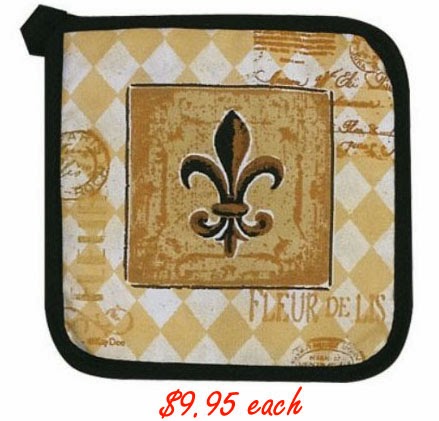
But, given my history, I'm not secure with just two pot holders at a time, so I kept looking until I came across another that greatly appealed to my well-documented feelings about bear country at the unlikely merchandiser of Blains Farm & Fleet (thank you Google, for turning them up):
Neither has arrived; both were ordered an unseemly number of days (like 10) ago and both were shipped USPS. The storied United States Postal Service is, for reasons you can easily imagine (e.g., it's associated with the government), notoriously susceptible to the vicissitudes of weather, and we most certainly have had lots and lots of vicissitudes this winter. Let's hope one pair or the other gets here before total meltdown. Of my remaining pot holders, I mean. This being the first half of February in Chicago, meltdown of the 13 or 14 packed inches of snow on the ground is unlikely until March.

Saturday, February 8, 2014

Teddy 2014

We haven't had a "Teddy post" for a long time. Teddy was a kitten when I found him huddled under a sapling tree very early one October 2009 morning along Chicago's lakefront, just 10 days after my beloved superannuated cat Winston, finally passed away. There are many posts about both kitties. Suffice it to say, we adored and mourned Winston, but Teddy has created his own world of love and fun, and comparisons with Winston's personality and physique yielded several blogs. To this day Teddy continues to be healthy, happy, robust, and endlessly playful. And endlessly hungry. He's had a good time this overly-snowy winter watching the big flakes snow globe around outside the window, as he is again today. He's such a good little addition to my life!

Saturday, January 11, 2014

From the Joke's on the Consumer Department

VALUE! 30% MORE vs. 4.6 oz size.
Caveat emptor. Ultrabrite (which is a very good, very inexpensive fluoridated toothpaste made by Colgate) isn't, and never has been, available in a 4.6 oz size.

Monday, January 6, 2014

Global warming is local: The Morning After (Chicago edition)

The couple of hundred yards of ice that was forming along our Lake Michigan shore yesterday has disappeared, due doubtless to shifting currents and wind direction. The water underneath was about 33o Fahrenheit today, and the air in our neighborhood was reported by the weather service to be about -11o (-24o Celsius). For the record it's now warmed up to -10o. The photo, taken from my dining room window shortly after sunup this morning, shows how that temperature differential causes clouds of surface steam. Amazing and beautiful.

Sunday, January 5, 2014

Global warming is local

Because the weather in Chicago today might best be described as "advanced winter crossed with snow globe" I hope you won't mind if I don't go outside to take pictures. Instead I'll use some from the archives to provide a visual approximation of what's going on.
Hudson Bay early freeze-up, 2012 = Lake Michigan today
At the corner of Kelsey and Franklin Streets, Churchill Manitoba = Lake Shore Drive, Chicago Illinois today
Ice-encased tree, Lamar Buffalo Ranch, Yellowstone 2010 = Chicago today, minus the crystal clear blue sky
My street following the Chicago "blizzaster" 2011 = my street today, except no one is outside, the street hasn't been plowed, and its still blowing and snowing heavily.
What I don't have is a proxy photo to represent today's white-out alternating with blowing horizontal snow. It's 23o Fahrenheit at the moment -- not an unreasonable temperature for early January -- in fact I would say that's a desirable temperature for the normal course of plant life, especially species that depend on prolonged cold to sprout and flower at appropriate times of the year, and that benefit from prolonged subfreezing temperatures to control insect infestation. However, with winds of 20+ miles per hour, the "real feel" against skin is much closer to 0o F. That's dangerous for humans and photographers alike. There are serious National Weather Service winter storm warnings in effect, and cancellations have already gone out from every place I'm due tomorrow including my employer (work from home) and my otherwise regular Jazzercise class (cancelled).
NASA's announcement of December 9, 2013 (just one month ago) that the coldest area on earth, in Antarctica of course, has now been documented by the Landsat 8 satellite, and wave following on wave of snow storms hitting the U.S. east coast this winter have delighted the global warming nay-sayers.  They take all of this as proof that global warming is a conspiracy of liberals and scientists (who are every bit as ignorant and misdirected as politicians in their view) intended to...well, I'm not sure what all negative motivations are attributed to proponents of the "theory" of global warming, but a predominant one is "it will be used to separate people from their coin" (quotation from a person who posts under a pseudonym on a chat page I frequent). While many are willing to admit that the earth's climate "ain't what it used to be" (in recorded history) they refuse to accept the possibility that the speed and average direction in which change is occurring are causally related to human activities. I agree that it's not only very hard to wrap one's head around apocalyptic visions (not just NIMBY attitudes, in fact, especially if they involve engulfing one's own weekend cottage at the beach), it's even more difficult to suggest that the way to preserve earth's future commodiousness for human, animal, and plant life involves significant changes in personal behavior. Who wants to give up their car? Who wants to give up hopping on a greenhouse gas-spewing jet plane to get to desirable destinations? Who wants their diet narrowed to locally produced food only? Who wants to give up eating methane-farting beef? Who above the Mason-Dixon line wants keep the thermostat at 68o F from October through April and at 78o from May through September?
My opinion is that if the scientists and policy-makers have messed anything up, it's certainly climate change public relations. The first and most damaging mistake was to  label (well documented and frightening) trends in world-climates as global warming as opposed to global climate change. Followed by the word "theory" which confirms for doubters that scientists admit global warming is unproven. And the slightest sign of disagreement among researchers (which, after all, is one of the great attributes of modern science: debate is essential and consensus on every detail is not) is taken as proof beyond a doubt that "they" don't know what they are doing. But scientists persist, enriching themselves from (supposedly) lucrative and career-boosting taxpayer-supported government grants that reward such claims.
What has not been conveyed adequately to the public is that weather, such as the unusual (but  certainly not unheard-of) phenomenon Chicago and much of the U.S. is experiencing today, is not climate.  However, many anomalies in weather, such as extreme cold with precipitation, and for that matter, extreme heat waves such as that being experienced in Australia are in fact caused by the gradual warming of the earth.
Global warming may be local, especially for those whose world is constrained by tunnel vision, but global climate change is not.

Wednesday, January 1, 2014

State parks are fantastic too: Part II.B - California, La Cuesta Encantada

I've visited and enjoyed the massive, sprawling, overwhelmingly opulent and magnificent Hearst Castle,  also known as La Cuesta Encantada (The Enchanted Hill) a couple of times over the past three or so decades, but I think I've finally gained sufficient life experience now to be awed by it in ways I could not be before -- it is, after all, an awful lot to take in. The Castle, for which ground was broken in 1919, is perhaps the greatest legacy of media baron William Randolph Hearst. It is now managed by the California State Parks, open for public viewing, and maintained to the highest museological standard.
Hearst (grandfather of the notorious kidnapping victim-cum-criminal-cum-model citizen, Patty Hearst)  was himself bigger than life, and his enterprises were fabulously lucrative, as woefully dys-imagined in the movie Citizen Kane. Not one to fritter away his fortune on profligacy (at least, not the usual kind), Hearst developed the family ranch overlooking the Pacific Ocean at San Simeon, California, into a mansion and estate beyond compare. Today it's a do-not-miss along California Highway 1.
The Castle was a 28-year collaboration between Hearst, with his money and acquisitive taste, and the brilliant architect Julia Morgan. Morgan, like Mary Jane Colter, was a standout in a field dominated by men, and like Colter, her considerable accomplishments beyond the the work for which she was best known during her lifetime (the Castle), was largely uncelebrated until recent years. Also like Colter, it seems she never had budget constraints. Nor limitations on the talent and skills she could recruit to import, build or restore, install, replicate, and maintain the exquisite treasures,  baubles, fancies, and architectural elements in their entireties, mostly of the Mediterranean world and from all eras, ancient to 1930's and 40's contemporary.
A turkey vulture gazes across the Hearst acreage to the "Castle" at the top of a 1,600 foot hill, San Simeon, California
We started the morning of our tour at our sea-level hotel, with the famous California fog so thick we could hear but not see waves sloshing on the beach across the street. We boarded a bus at the visitor center a few miles away and were driven up along the winding road until suddenly we popped through the fog and found ourselves looking down at a bright cloud deck of puffy white shining in the California sun, exactly as if we had ascended in a plane. 
We gathered at the foot of the facade of the La Casa Grande (the big house, main house) to admire its busy decoration and to take a look up into the bell towers.  Inside we found ourselves in the cavernous Assembly Room, too dark to photograph well, but designed to cushily accommodate large numbers of guests for cocktails prior to proceeding to dinner in the so-called Refectory.
At this "modest" dining table the Hearsts (William Randolph and his wife Millicent, and, after their separation, WR and actress Marion Davies, his companion for the rest of his life) hosted society's luminaries from politicians to Hollywood mainstays to businessmen and celebrities of all ilks.
It's hard to imagine that the Hearst dinner parties were ever described as "casual," but that's the way he wanted them.
Next up was the Billiard Room, lined with this huge 15th century French tapestry hunting scene  to suggest, I suppose, that the room is meant for the recreation of very well-dressed people. 
No object in the Hearst Castle, however old or new, is in less than exquisite condition.
The final interior room of our tour was the movie theater in which Hearst and guests, and, apparently also the staff, enjoyed movies produced at Cosmopolitan Productions, owned by none other than WR, of course. (Most of the movies were not memorable, but were certainly money-makers at the time.) I've not been able to establish seating capacity, but it was at least 50. In the cavernous room too dark for my photo purposes, this shot of  a "simple" life-sized wall sconce well represents the general idea.
Not to be outdone by the interior are the vast gardens with free-standing guest mansionettes, swimming pools, tennis courts, sculptures, fountains, and luxuriant flora. Here is Casa del Monte, guest house "B" (out of three) which is doubtless larger, prettier, and most certainly better attended and accoutred, than the average American middle class home:
Sculptures and fountains and embellishments abound:
 
In spite of its prominence in views up to the Casa Grande from the Neptune Pool (see below), I've been unable to identify this lovely Spanish-style fountain. Perhaps rather than being an original object of great value, it is a cheap imitation. One of the annoying shortcomings of the Castle-as-museum is the complete absence of labels or on-line access to catalogs of the holdings. I wouldn't be surprised if this is intentional, so as not to spoil the illusion that this was a real home, albeit inhabited by its owner part-time, and by people who do not seem particularly real.
Another unidentified but charming garden ornament.
Detail, ironwork screen on one of the guest houses created by Californian Edward Trinkkeller
No opportunity to add detail was passed up.
The iconic ultimate outdoor attraction at Hearst Castle is the 345,000 gallon Neptune Pool with its complex period architectural and decorative references and sky-mirroring color.
Hearst collected live exotica as well:
Some species, like the poor polar bears and elephant, lived mostly in the confines of a zoo. Others, like these Grey's zebras, progeny of the originals, were free to graze with the beef cattle on what is now the Hearst Corporation Ranch. 
By the time we had to go on our way the fog had cleared, revealing views all the way to the Pacific Ocean, providing a taste of what it was that Hearst so loved about this spot.
This report barely touches the surface of La Cuesta Encantada's epic. The researching and writing of it has brought home of how little I was able to absorb, even on this visit as a more worldly person than on previous encounters. It would be an enormous indulgence to go back again too soon, though. But indulgence is the name of this game, is it not?